

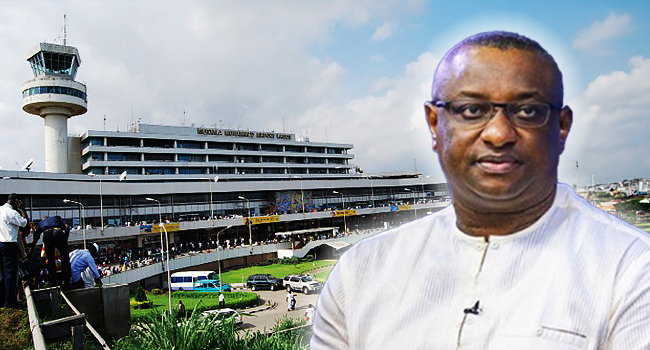
The Minister of Aviation and Aerospace Development, Festus Keyamo, has said the removal of the fuel subsidy enabled the President Bola Tinubu administration to increase investment in critical aviation infrastructure, including raising about $500 million for the reconstruction of the Lagos airport and other targeted projects within two years.
Keyamo disclosed this on Monday at the 67th anniversary celebration of Aero Contractors Airline in Lagos.

The minister spoke while outlining the administration’s investments in the aviation sector, in response to a question from the airline’s Managing Director on the state of the industry under the Renewed Hope Agenda.
Keyamo explained that the funds used for the infrastructure projects were not obtained through borrowing, but were made possible by improved liquidity and increased foreign reserves.
He said, “Let’s be honest. Forget about what the politicians are saying. You know, we are all politicians. But I am saying, in actual fact, that is what happened.
“The President raised $500m to rebuild the Lagos airport. Not money borrowed, because we were able to do what we should do. Our liquidity rose. Our foreign reserves also rose from $3bn to $56bn now.
“And investors are rushing into the country because they now see the country as viable.”
The minister’s remarks come amid debate over the economic consequences of the removal of fuel subsidy, particularly its impact on household incomes and the rising cost of food, transportation and other essential goods.
While critics have questioned the relevance of stronger foreign reserves to Nigerians facing economic hardship, Keyamo argued that macroeconomic stability was crucial to attracting the foreign investment required to create jobs and develop infrastructure.s
He stated, “People say, ‘What will foreign reserves do for the economy? People are hungry.’ You know, this is the cheap talk they engage in to play on cheap sentiment.
“They will say people are dying and so on. All those things they are saying are cheap blackmail.”
Keyamo further stressed that the focus should instead be on how Nigeria could position itself to attract investors capable of bringing capital, infrastructure and employment opportunities into the country.
Questioning the rationale behind agitation for the suspension of the subsidy removal, he said, “Tell me, what exactly will bring investors? What will bring jobs? Tell me.
“It is when foreign investors see that you are healthy, your economy is healthy, and your foreign reserves are healthy that they will come into the country. They will build infrastructure, they will bring in money, and they will bring jobs.
“And that is what brings jobs. That is what creates jobs.”
He stressed that employment could not be created simply through government pronouncements, arguing that sustainable jobs were linked to investment and infrastructure development.
He said, “Jobs don’t fall from heaven, jobs come as a result of either the infrastructure you are building or investments. That is how jobs are created.”
The Lagos airport project, according to the minister, is part of a broader effort by the Tinubu administration to upgrade Nigeria’s aviation infrastructure and position the sector to support economic growth.
He added that the government’s aviation agenda extends beyond Lagos.
Keyamo said Tinubu had also approved the return of the China Civil Engineering Construction Corporation to the Abuja airport project for the construction of the long-delayed second runway at the Nnamdi Azikiwe International Airport.
“The President is not only stopping at rebuilding Lagos International Airport. Mr. President has also approved that CCECC go back to build the second runway in Abuja now,” he said.
The Abuja runway project has been stalled for years, with disagreements over its cost and funding contributing to delays.
Keyamo recalled the controversy surrounding the project when its estimated cost was about N45bn, saying the proposed expenditure had faced resistance at the time.
“Why did we not build the second runway all along? Don’t forget what happened regarding the second runway. I remember vividly then. I wasn’t here at the time, but I followed the arguments and the debate,” he said.
According to him, the National Assembly had raised concerns that N45bn was too much to spend on the project.
“The National Assembly fought that project because they said that N45 billion was too much to spend on the second runway,” he said.
“And so, the Committee on Aviation at that time all rested, an embargo was put on it. We could not raise N45bn at that time to build the second runway. Fifteen years later, or maybe 20 years later, it is now costing us nearly ₦500bn,” he said.
Keyamo insisted that the link between investment and employment was attracting capital, developing infrastructure and creating an environment in which investors have confidence.
He said, “Jobs don’t fall from heaven, jobs come as a result of either the infrastructure you are building or investments. That is how jobs are created.”
