

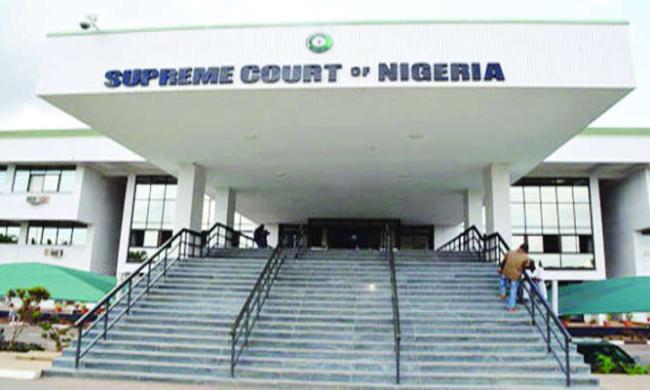
The Lagos state government has filed an application before the supreme court, seeking permission to commence contempt proceedings against the national assembly over the central gaming bill.
In the motion submitted on behalf of the Lagos attorney-general by Bode Olanipekun, senior advocate of Nigeria (SAN), the state is asking the supreme court to grant leave to begin judgment-enforcement actions through the issuance of form 48.

Form 48 serves as a formal notice warning of the consequences of disobeying a court order and represents the first step toward initiating contempt proceedings.
BACKGROUND
In recent months, tensions have escalated between the Lagos state government and the national assembly over the Central Gaming Bill, 2025, which aims to “regulate the operation and business of online gaming across all states in Nigeria, including a specific provision for activities in the federal capital territory (FCT)”.
The bill is currently under consideration at both the senate and the house of representatives.
The proposed law seeks to create a regulatory structure for remote and online gaming nationwide. It is intended to replace the repealed National Lottery Act of 2005.
However, Lagos argues that the bill violates the supreme court judgment delivered in November 2024, which invalidated the enforcement of the National Lottery Act 2005 across the 36 states.
According to the state government, regulation of gaming and lottery falls strictly under state jurisdiction, not federal control.
THE SUPREME COURT’S JUDGMENT
In November 2024, the supreme court delivered a unanimous judgment nullifying the enforcement of the National Lottery Act 2005 in all states.
The seven-member panel ruled that the national assembly lacks constitutional authority to legislate on lottery and gaming matters.
The court held that lottery and gaming cannot be classified under “trade and commerce” on the exclusive legislative list of the 1999 Constitution.
The ruling affirmed that only state assemblies have the legislative power to regulate gaming and lottery activities.
The National Lottery Act 2005 was signed by former President Olusegun Obasanjo.
The Lagos state government initiated a legal challenge in 2008, questioning whether regulation of gaming and lottery belonged on the exclusive legislative list.
Ekiti state joined the case in October 2020 as a co-plaintiff.
Subsequently, additional states aligned either as co-plaintiffs or co-defendants, depending on their stance.
‘PROPOSED BILL RELATES TO LOTTERY, GAMING’
In an affidavit supporting the motion, Lagos contends that the proposed legislation before the national assembly deals entirely with lottery and gaming—areas which the supreme court has already ruled fall outside the federal legislature’s power.
The affidavit notes that both the repealed National Lottery Act of 2005 and the new bill define “gaming” and “lottery” in similar terms.
The state further argued that since the supreme court judgment in November 2024, no amendment has been made to the exclusive legislative list to place lottery or gaming under federal authority.