

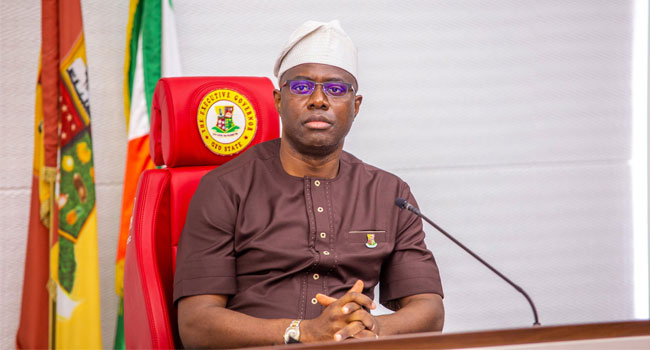
The Governor of Oyo State, Seyi Makinde, has said that political leaders and key stakeholders must reach an elite consensus for Nigeria’s federal system to deliver the results envisioned by the country’s founding fathers, particularly Obafemi Awolowo.
Makinde made the statement on Friday during the 2026 Obafemi Awolowo Memorial Lecture held at Efunyela Hall, Obafemi Awolowo Residence in Ikenne. The information was contained in a statement issued by his Special Adviser on Media, Dr Sulaimon Olanrewaju, and made available to journalists in Ibadan.

The governor praised Awolowo for his foresight and strong support for federalism, describing him as a leader who relied on careful analysis and strategic thinking. He, however, noted that later leaders in the country became complacent over time.
“Well, I think we became complacent over the years. Papa Awolowo, before tackling any challenge, he would look at the data, the logic behind those things, and he would look at the science. Those were the tools he used to make decisions.
“But here, now you see that leadership is such that we just make decisions because we think we are playing politics or because we think, oh, it is nice to have,” he said.
Makinde also stated that his administration in Oyo State has been following the developmental principles championed by Awolowo.
“If you look at the cardinal programmes of Papa Awolowo, you have education, you have health, you have economic emancipation. If you add security to it, that is exactly what we are doing in Oyo State.”
He maintained that federalism remains the best system for Nigeria because of its diverse nature but stressed that leaders must unite and focus on the nation’s future rather than immediate political interests through what he described as an elite consensus.
He explained that an elite consensus occurs when the ruling class and political leaders collectively agree on long-term national goals that promote stability, guide policies and sustain the country’s system of governance.
According to the governor, failure to reach such an agreement could leave Nigeria facing prolonged challenges in the future.
“Yes, I agree, true federalism is the way to go. But you need elite consensus. Yes, we all need to come together. We should stop thinking about the next election. Let us think about the next generation.
“There are two countries in Africa that have passed through very difficult situations, perhaps more difficult than Nigeria. I have been talking to our past military leaders.
“Some of them served in the Democratic Republic of Congo as part of the United Nations contingents. One of them said he was there in 1960. The other one said he was there in 1961.
“Okay, let us fast forward — 1960 to 2026, that’s 66 years. The two former military leaders were there for peacekeeping when rebels overran Eastern DRC after they killed Patrice Lumumba.
“Now, in December of last year, I was watching on TV the president of Rwanda and the President of DRC, they were signing a peace agreement because rebels had not stopped operating in Eastern DRC. That is a period of 65 years.
“If we don’t do something about our situation in Nigeria, 100 years from now, we will still be in the same situation, because we have seen it happen elsewhere.
“Here is another scenario. Rwanda faced a genocide; almost a million people were killed in 1994. But if I ask anybody in this room today, If you are likely to transit through a country to go to Asia, which country will it be? Very likely, it would be Rwanda because they took up the challenge. They fixed their country. And now everybody wants to go right there. So, we have to do what Rwanda did if we want a change in our trajectory.”
The lecture was attended by several prominent figures, including former governors Gbenga Daniel and Olagunsoye Oyinlola; Minister of State for Health, Isiaq Salako; the Deputy Governor of Ogun State, Noimot Salako-Oyedele; founding member and Executive Director of the Obafemi Awolowo Foundation, Olatokunbo Awolowo Dosumu; former Commonwealth Secretary-General Emeka Anyaoku who chaired the event; patron of the foundation Nnaemeka Achebe; and Ladi Adebutu, among others.
