
Mali defence chief killed as violence escalates

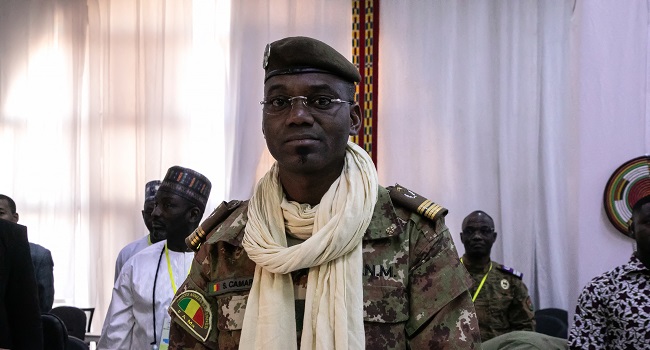
Mali’s defence minister has died following an attack on his residence, his family confirmed on Sunday, as the military engaged in a second day of clashes with jihadist fighters and separatist rebels near the capital, Bamako, and other cities, placing the ruling junta under significant strain.
Defence Minister Sadio Camara, his second wife, and two grandchildren were killed in a car bomb explosion at his home in the junta stronghold of Kati, located outside Bamako, according to family members and an official.

The coordinated attacks on Saturday, carried out by Tuareg rebels from the Azawad Liberation Front (FLA) coalition alongside the jihadist Group for the Support of Islam and Muslims (JNIM), targeted multiple locations across the expansive and largely arid country.
Fighting continued into Sunday in several areas, including Kati, Kidal, Gao, and Severe.
Meanwhile, Tuareg rebels announced that an agreement had been reached allowing Russian forces supporting the Malian army to withdraw from the northern city of Kidal, which they claimed to have brought “totally” under their control.
“An accord has been reached permitting the (Malian) army and its (Russian) Africa Corps allies to leave the camp 2, where they were holed up since yesterday,” a Tuareg official told AFP.
A resident added: “We saw a military convoy leave, but don’t know the details of what’s happening … Fighters from armed movements have now taken over the streets.”
Kidal, a known Tuareg stronghold, was recaptured in November 2023 by the Malian army with support from Russia’s Wagner paramilitary group, ending more than a decade of rebel control.
The FLA also claimed to have seized positions in the northern Gao region.
“The aim of the attackers was not to seize and control cities, but to carry out coordinated actions in order to at least capture Kidal, which is a rather powerful symbol,” a security source told AFP on Sunday.
Mali has endured over a decade of conflict and jihadist insurgency, but Saturday’s assaults represent the most severe escalation since the junta took power in 2020.
The attacks occurred on the outskirts of Bamako and across several towns and cities in the Sahel nation.
Residents on edge
The violence left 16 civilians and soldiers injured and resulted in what the government described as “limited material damage” in a statement issued on Saturday evening.
Authorities maintained that “the situation is totally under control in all the localities” affected by the attacks.
In the capital, access to military installations has been restricted with roadblocks and tyres, according to an AFP journalist.
In Senou, a district near the airport that experienced heavy fighting on Saturday, residents reported heightened anxiety.
“I still hear the blasts ringing in my ears. It’s traumatising,” one resident said.
Although Kati was reportedly calm after “the jihadists left the area”, a resident noted: “we are living in fear”.
United Nations chief Antonio Guterres condemned the “acts of violence” in Mali.
“The Secretary-General is deeply concerned by reports of attacks in several locations across Mali,” his spokesman said in a statement.
“The Secretary-General calls for coordinated international support to address the evolving threat of violent extremism and terrorism in the Sahel and to meet urgent humanitarian needs,” spokesman Stephane Dujarric added.
The European Union also condemned the “terrorist attacks” in Mali on Sunday.
Russia’s Africa Corps, operating under the control of the Russian defence ministry, has replaced the Wagner group in supporting Malian forces in their fight against jihadists.
Mali, rich in resources such as gold and other valuable minerals, has in recent years distanced itself from former colonial power France and several Western nations, strengthening its ties with Russia.