

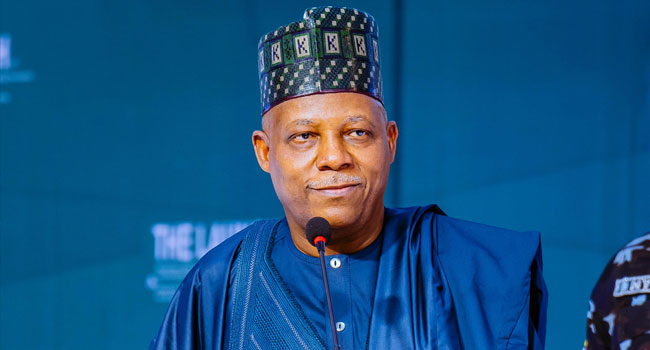
Vice-President Kashim Shettima says Nigeria will mobilise $3 billion annually to finance reforestation, blue carbon, and other community-led climate projects in the country.
Shettima made the remarks on Thursday at the ongoing COP30 leaders’ summit in Belém, Brazil, where he represented President Bola Tinubu.

The high-level event precedes the formal climate negotiations scheduled to run from November 10 to 21, during which countries are expected to advance discussions on adaptation, finance, and nature-based solutions.
According to Shettima, the funds will be mobilised through the country’s national carbon market framework and climate change fund, both designed to support projects that link nature restoration with economic growth.
“Nature should not be seen as a commodity to exploit but as critical infrastructure for sustainable development,” the vice-president said.
“Our forests, oceans, and landscapes are shared global assets that require collective responsibility and investment.”
He added that the initiative will support reforestation and blue carbon programmes, alongside climate-smart agriculture and other local adaptation efforts.
The vice-president also said the programme will focus on creating green jobs for young people and women, while positioning Nigeria as a regional leader in nature-positive investments.
Shettima emphasised that Nigeria’s approach integrates environmental protection into its climate finance architecture, reinforcing the link between nature, the economy, and social development.
He called for stronger global solidarity and climate justice, noting that countries in the Global South — which have contributed least to climate change — continue to face its harshest impacts.
To help close this gap, he urged developed nations to scale up grant-based financing, activate blue carbon markets, and support debt-for-nature swaps that would allow developing countries to reinvest in conservation.
Shettima also highlighted the importance of community-led governance, stating that indigenous people, farmers, and fisherfolk must be recognised and rewarded for protecting natural ecosystems rather than displaced by conservation projects.
He noted that Nigeria is implementing several initiatives to restore ecological balance, including the great green wall programme, the national afforestation programme, and the marine and blue economy policy.
These initiatives aim to restore millions of hectares of degraded land by 2030 and ensure sustainable management of the country’s marine resources.
Shettima added that Nigeria is collaborating with other African countries through frameworks such as the African nature finance framework, which seeks to attract private investment into reforestation, ecosystem restoration, and blue economy development across the continent.