

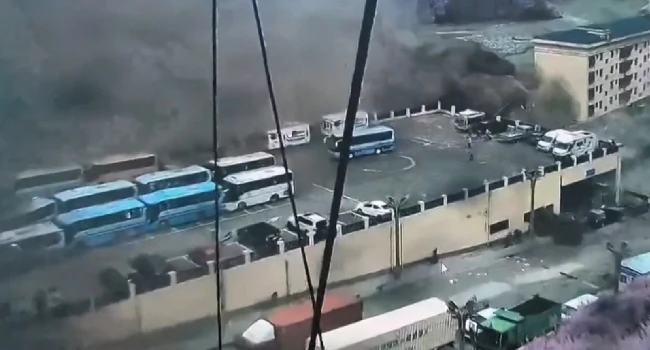
At least 95 people have been killed and 384 tourists reported missing after a massive flood swept through Nepal’s northern Rasuwa district near the border with China.
The Nepal Tourism Board said 291 of the missing travellers were foreign nationals, while 93 were Nepali citizens. Americans, Indians, an Australian, Malaysians and Britons were among those reported missing, although authorities were still working to verify their whereabouts.

The disaster struck the Syabrubesi area, a gateway to the popular Langtang trekking region and a route used by pilgrims travelling towards Mount Kailash and Lake Mansarovar.
Nepal Police spokesperson Abi Narayan Kafle confirmed that the death toll had risen to 95, while 28 police personnel were also reported missing.
A torrent of mud, water and debris swept through mountain valleys, destroying buildings and damaging roads and other critical infrastructure.
“We do not exactly know the extent of damage, but the flood is big, and it could have damaged many settlements,” Kafle told AFP.
Images released by Nepal Police showed powerful floodwaters carrying debris through the affected area, while photographs from the scene showed buildings partly buried in mud.
Authorities had previously warned residents living close to rivers to relocate and deployed available resources to affected communities.
Power, roads damaged
The Nepal Army has deployed helicopters and disaster-response personnel to support search and rescue operations.
Prime Minister Balendra Shah also convened an emergency meeting of the National Disaster Risk Reduction and Management Authority to assess the situation and coordinate the response.
“Work has started to take necessary steps in coordination with the medical team, scouts, and Red Cross,” Shah said in a social media post.
The flooding also caused extensive damage to Nepal’s electricity infrastructure.
The Nepal Electricity Authority said about 430 megawatts of generation capacity, including hydropower and solar facilities, had been affected.
“The disaster has damaged the production, transmission and distribution facilities of the Authority,” it said, adding that electricity supplies had been disrupted.
Several highways were also closed following the flooding, making rescue and relief operations more difficult.
Rescue operations continue
The disaster affected areas close to Nepal’s border with China, where Chinese state media also reported major casualties following a mudslide at the Gyirong Port on the Tibetan side of the border.
Footage broadcast by Chinese state television showed rushing water carrying tree branches and debris while flooding roads.
Chinese President Xi Jinping ordered an “all-out” rescue operation, directing authorities to search for missing people, treat the injured and minimise casualties.
Traffic authorities in Tibet’s Shigatse also warned that roads in the area were at risk of mudslides and unsafe for travel.
Nepali remote-sensing analyst Sarthak Shrestha said a preliminary assessment indicated that a rock-and-ice avalanche may have blocked the Lhende River in Nepal, triggering the flooding.
Authorities have also warned of the possibility of another flood because of a blockage upstream along the river near the Nepal-China border.
Qianggong Zhang, head of climate and environmental risks at the International Centre for Integrated Mountain Development, urged authorities to remain alert to the possibility of a second flood.
Monsoon rains between June and September regularly cause floods and landslides across South Asia, while scientists have warned that climate change is increasing the frequency and intensity of extreme weather events.
The European Union said it had activated its Copernicus satellite surveillance system to help map the affected areas and support recovery efforts.
“Copernicus has been activated to help map the affected areas in Nepal and support the response on the ground,” EU Commission President Ursula von der Leyen said.
“We stand ready to mobilise further European assistance.”
Rescue teams continued searching for missing people as authorities worked to determine the full extent of the destruction.