

Nigeria’s index case of Ebola virus disease is expected to be evacuated abroad for further medical treatment on Monday, October 26, according to a source familiar with the development.
The source told THISDAY that arrangements had been made to fly the 42-year-old woman out of the country by 6 am, adding that a medical evacuation aircraft was already at the airport awaiting her arrival.

The development comes as the Nigeria Centre for Disease Control and Prevention (NCDC) confirmed that two suspected Ebola cases in the Federal Capital Territory (FCT) and Rivers State had tested negative.
The agency also disclosed that 53 primary contacts of the confirmed case had been identified and were being monitored.
According to the NCDC, the Federal Government was considering paying N100,000 weekly to support quarantined contacts following complaints about their welfare.
However, the agency said the proposed welfare arrangement was temporary, as state governments were expected to take responsibility for maintaining contacts within their jurisdictions.
“The medivac plane is already at the airport waiting to evacuate her,” the source said, adding that the Federal Government was expected to announce the development after the patient had left Nigeria.
The planned evacuation comes amid intensified surveillance and contact-tracing efforts by Nigerian health authorities to prevent further transmission of the disease.
NCDC provides update on Ebola response
Earlier, the Director-General of the NCDC, Dr Jide Idris, provided an update on the country’s response to the outbreak during a press briefing in Abuja.
Idris said efforts to identify additional secondary contacts were ongoing, assuring Nigerians that the Federal Ministry of Health and Social Welfare, the NCDC, FCT health authorities and their partners were committed to containing the outbreak.
“As previously announced, Nigeria has confirmed one case of Ebola disease caused by the Bundibugyo virus. The patient is currently receiving medical care under isolation, with infection prevention and control measures in place. Clinical teams continue to monitor and manage patient’s condition,” he said.
According to Idris, the 53 primary contacts include 44 personnel from the hospital where the index case is receiving treatment. The remaining contacts include nine people linked to the index case, three people from the Julius Berger office she visited before developing symptoms, and three health workers who attended to her.
He said samples collected from the woman’s husband had tested negative. The two suspected cases in the FCT and Rivers State also tested negative, but would undergo further monitoring.
Addressing questions about the identity of the index case, Idris said she was from Uganda and married to a Swiss national. He added that the government was investigating her travel history to establish her exact movements.
He said Nigerian officials would hold a virtual meeting with their Ugandan counterparts to exchange information.
Idris explained that the case was detected through event-based surveillance after healthcare workers recognised clinical symptoms that raised concerns.
He said the response was being coordinated through a structured Incident Management System under the Emergency Operations Centre, led by the Coordinating Minister of Health and Social Welfare, Prof Ali Pate, and the Presidential Task Force on Ebola virus disease.
The NCDC director-general identified key response measures as tracing and monitoring contacts for 21 days, providing safe clinical care, strengthening infection prevention and control in health facilities, improving surveillance and laboratory capacity, and engaging communities.
He added that the centre was receiving assistance from the Department of State Services (DSS) to track contacts, had expanded the case definition for community surveillance and was strengthening the genomic capabilities of 12 laboratories to test for Ebola.
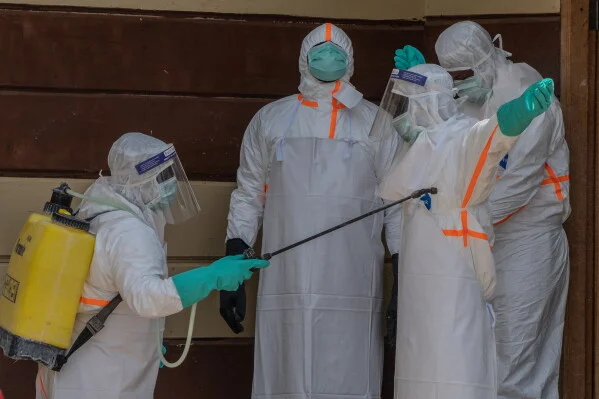
The government has also designated the University of Abuja Teaching Hospital as a special isolation centre and fumigated the index case’s premises.
On the welfare of contacts, Idris said the Federal Government was considering providing N100,000 weekly for the feeding and upkeep of each quarantined contact, while state governments were expected to take responsibility for contacts within their jurisdictions.
He urged Nigerians to cooperate with contact-tracing teams, provide accurate information and comply with public health advisories.
“An identified contact does not mean you have Ebola. It means public health teams need to assess and monitor your health,” he said, advising the public to maintain hand hygiene, avoid contact with the blood or bodily fluids of suspected cases and report symptoms promptly.
Idris commended healthcare workers whose vigilance led to the detection of the case and urged public and private health facilities to strengthen screening, triage and the availability of personal protective equipment.
Recalling his experience leading Lagos State’s response to the 2014 Ebola outbreak as commissioner for health, he said lessons learnt in leadership, coordination and public trust were being applied to the current response.
He also warned against misinformation and stigmatisation, urging Nigerians to rely on verified information from the NCDC and the Federal Ministry of Health.
“The government has worked hard to strengthen the surveillance system and boost capacities of disease testing laboratories. Success depends on the whole of society,” he said, adding that the patient was improving.
WACP summit to address Ebola and other health challenges
Meanwhile, the West African College of Physicians (WACP) is set to discuss Ebola and other major healthcare challenges facing the region as it marks its 50th anniversary with a summit in Abuja beginning on Monday.
Other issues expected to feature at the meeting include brain drain, infrastructure deficits and infectious disease control.
The college had earlier visited President Bola Tinubu at the State House in Abuja, where he urged its members to help develop solutions to pressing healthcare challenges across the region.
Speaking at a press conference on Saturday, WACP President Dr Mamadou Mourtalla said the college would assess developments in the health sector, including scientific discoveries, medical training, infrastructure and infectious disease control.
“We’ll be discussing various perspectives, how to deal with the pandemic, an epidemic coming up in Africa which puts a lot of stress on our health system. We have over 70 scientific papers based on this theme. At the end, we usually issue a communique,” Mourtalla said.
He stressed the importance of implementing the summit’s resolutions, adding that the President of the ECOWAS Commission, the Director-General of the West African Health Organisation and President Tinubu, who had promised to send the health minister, would participate in making recommendations to regional leaders.
WACP Assistant Secretary-General Dr Habibu Galadanci said the conference would examine several issues, including brain drain, infrastructure deficits, the rise in non-communicable diseases such as kidney disease and hypertension, and infectious disease outbreaks, including Ebola.
“The scientific content will touch on several aspects of medicine, including disease conditions, health policies and contemporary medical issues,” he said.
On brain drain, Galadanci said the conference would examine the factors driving healthcare professionals to leave their countries and explore possible solutions.
“There are pull dynamics, push dynamics, and we are going to look at that and find solutions. When we saw President Tinubu, that was one main thing he charged us with, that we should discuss Japa syndrome and find solutions,” he said.
He added that discussions would cover the use of artificial intelligence in medicine, ethical issues in patient management, maternal and reproductive health, access to safe healthcare for women and children, mental health priorities and balanced scorecards for improving public hospitals.
Galadanci described the conference as an opportunity to review the college’s achievements over the past 50 years and identify outstanding challenges.
“We still have a lot of problems, but we have come a long way, at least we can train our doctors. We have specialists, so many doctors that they poach them from outside because of how good we are,” he said.
Other topics include kidney disease, dementia amid an ageing population and mental health, which he said was often stigmatised and downplayed.
As part of its corporate social responsibility activities, WACP members organised a medical outreach in Waru community, a suburb of the FCT, on Saturday, providing free healthcare services to a large number of men, women and children.
The week-long summit in Abuja is expected to attract more than 1,300 experts from across West Africa to develop recommendations for addressing healthcare challenges over the next 50 years.