

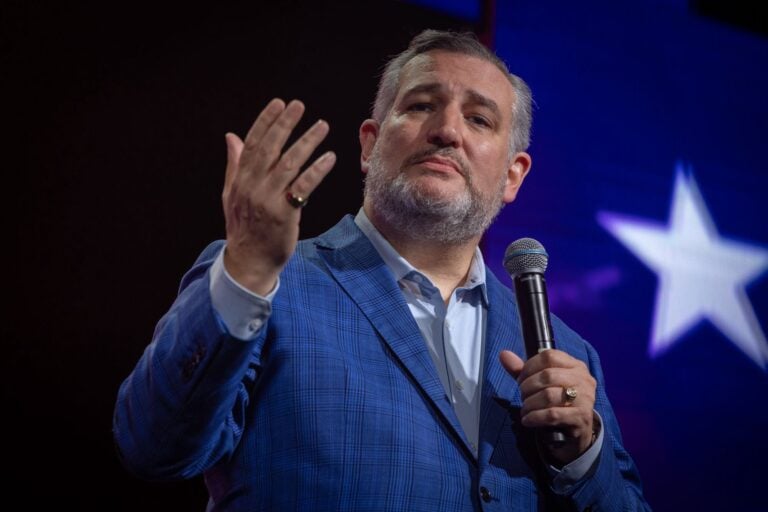
United States Senator Ted Cruz has accused the Nigerian government of using public relations and lobbying campaigns to deflect attention from the killing of Christians and the country’s wider security challenges.
Cruz expressed disappointment over Nigeria’s engagement of a US-based lobbying firm to communicate the government’s efforts to protect Christians to the American government, describing the move as an attempt to avoid addressing concerns over the country’s worsening security situation.

The senator’s comments came as Timi Frank, a former deputy national publicity secretary of the All Progressives Congress (APC), accused the Presidency of misleading Nigerians by presenting a reported letter from US President Donald Trump as an endorsement of President Bola Tinubu’s administration.
Nigeria’s $9m lobbying contract
Nigeria reportedly hired DCI Group, a US-based public affairs and lobbying firm, under a $9 million contract in December, several months after the country was designated a ‘country of particular concern’ by Trump.
According to a lobbying contract filed with the US Department of Justice, Aster Legal, a law firm based in Kaduna State, engaged DCI Group on behalf of National Security Adviser Nuhu Ribadu.
The development followed the introduction of several measures by US lawmakers aimed at pressuring the Nigerian government to take stronger action against insecurity.
Cruz, who proposed the ‘Nigeria Religious Freedom Accountability Act of 2025’ in October, said the legislation was designed to hold Nigerian officials accountable for “facilitating the mass murder of Christians”.
In a post on X on Wednesday, the senator reiterated his position.
“Nigerian officials have created an environment that facilitates mass violence against Christians and religious minorities by imposing blasphemy and Sharia laws and looking the other way at jihadist atrocitiesd.
“The U.S. government knows the Nigerian officials responsible for these policies, I have been pushing my bill to sanction them, and President Trump has even ordered military action.
“Instead of responding to American concerns, Nigerian officials waged a public relations campaign against critics. They were confident in that campaign and in their ability to continue the status quo, and I am heartened that the House has just definitively proven them wrong.”
Cruz made the comments in response to an amendment passed by the US House of Representatives seeking to increase the withholding of assistance to Nigeria from 50 per cent to 100 per cent until the country takes effective measures to prevent and respond to violence within its territory.
The amendment was approved through a voice vote last Wednesday.
Cruz is not the only US lawmaker to criticise Nigeria’s lobbying efforts. Around the same period, Matthew Tonlagha, vice-chairman of Tantita Security Services, reportedly hired Valcour Global Public Strategy, a Washington-based lobbying firm, to assist with “strengthening the bilateral relationship” between Nigeria and the US.
Chris Smith, chairman of the House Foreign Affairs Africa subcommittee, said the deals demonstrated that “a culture of denial by Nigerian officials persists.”
Frank accuses Presidency of misleading Nigerians over Trump’s letter
Meanwhile, Frank accused the Tinubu administration of deceiving Nigerians over a reported letter from Trump, arguing that the correspondence was merely a diplomatic communication acknowledging security cooperation between Nigeria and the US.
He said the letter should not be used to overshadow questions surrounding documents relating to allegations about Tinubu’s past drug-related case in the US.
Frank, in a statement issued in Abuja, challenged the Presidency to publish the full document to establish its authenticity.
“The letter is not from the White House. If it doesn’t have the White House seal and the signature of the President of the US, it appears dubious at best,” Frank said.
He argued that the letter only recognised Nigeria’s cooperation with the US in tackling insecurity and did not amount to an endorsement of Tinubu’s leadership, economic policies or administration.
“The letter only commended Nigeria for partnering with the US in addressing insecurity. That is the only reason President Trump may have written it. It was not an endorsement of President Tinubu’s leadership, his economic policies or his administration.
“It did not say the Trump administration is backing President Tinubu or supporting him for any election in Nigeria.
“The Presidency is only trying to change the narrative by presenting it as something more than it is,” he said.
Frank, who is the United Liberation Movement for West Papua (ULMWP) Ambassador to East Africa and the Middle East, alleged that the publicity surrounding the reported letter was intended to divert attention from discussions over documents linked to allegations concerning Tinubu’s past drug-related matters.
He also questioned why the letter, reportedly dated July 6, only became public weeks later, arguing that a major political endorsement from Trump would likely have been released immediately.
Frank recalled that former President Muhammadu Buhari had been invited to the White House during Trump’s first term, arguing that such direct engagement carried greater diplomatic significance than a reported letter.
The former APC spokesman also questioned reports that the Federal Government had spent millions of dollars on lobbyists in the US to improve its international image.
“Ultimately, credibility and integrity cannot be conferred by a letter, a diplomatic exchange or a public relations campaign. They are earned through transparent leadership, accountability, respect for democratic institutions and faithful service to the people,” Frank said.