

The Federal Government has defended President Bola Tinubu’s reform agenda, insisting that Nigeria is gradually overcoming economic fragility and building a foundation for sustainable growth despite the hardships associated with ongoing reforms.
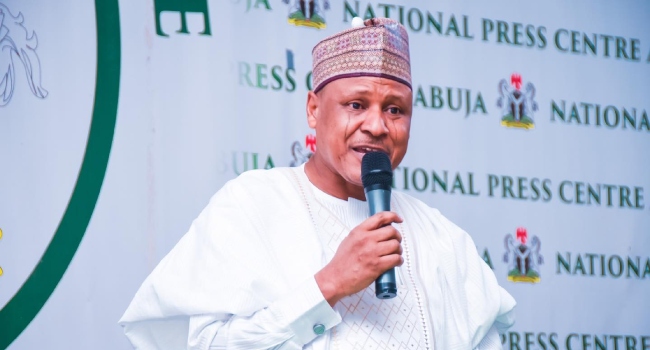
Speaking at a Democracy Day press conference in Abuja to commemorate 27 years of uninterrupted democratic governance and the third anniversary of the Renewed Hope Agenda, senior government officials said available indicators show the country is on a path of recovery, economic growth and institutional strengthening.

Minister of Information and National Orientation, Mohammed Idris, described Democracy Day as a moment for reflection, accountability and celebration of Nigeria’s democratic journey.
He paid tribute to late Chief Moshood Kashimawo Olawale (M.K.O.) Abiola and other pro-democracy activists, including President Tinubu, for their roles in the struggle that restored civilian rule in 1999.
According to Idris, this year’s Democracy Day is particularly significant as it coincides with the administration’s third anniversary, offering an opportunity to evaluate the impact of policies under the Renewed Hope Agenda.
“Twenty-seven years of uninterrupted democratic governance is a milestone worthy of celebration. It reflects the determination of Nigerians to uphold democratic values, strengthen institutions and build a more prosperous nation,” he said.
Representing President Tinubu, Secretary to the Government of the Federation (SGF), Senator George Akume, acknowledged the economic difficulties facing Nigerians but maintained that reforms are beginning to deliver positive outcomes.
“Government will never claim that every challenge has been solved. Inflation has been painful, insecurity still threatens lives and livelihoods, and the effects of reform do not land evenly or immediately.
“However, evidence shows that Nigeria is moving in the right direction, from fragility toward firmer footing, from stop-gap actions toward systemic reform, and from scattered interventions toward a more connected programme of delivery,” Akume said.
Akume disclosed that Nigeria’s economy sustained positive growth over the last two quarters, citing National Bureau of Statistics data showing GDP growth of 4.07 per cent in the fourth quarter of 2025 and 3.89 per cent in the first quarter of 2026.
He said the figures reflect increasing investor confidence, stronger market activity and improved productivity across sectors.
The SGF also highlighted fiscal reforms, including four major tax laws signed by President Tinubu in June 2025 aimed at simplifying tax administration, improving transparency and boosting revenue generation.
One of the administration’s major achievements, according to Akume, is the Student Loan Scheme.
He revealed that since the Student Loan Act was signed in April 2024, the Nigerian Education Loan Fund (NELFUND) has supported more than 1.058 million students across the country.
More than N184 billion has been disbursed for tuition and upkeep allowances.
“The public impact analysis shows that over 1.058 million students have already benefited from the scheme,” he said.
The government also reported progress in its social intervention programmes.
Akume said the Renewed Hope Conditional Cash Transfer Programme had reached over three million vulnerable households by August 2025 as part of efforts to support 15 million households nationwide.
He added that nearly one million Nigerians have benefited from interventions under the Presidential Conditional Grant Scheme and CreditCorp across the 774 local government areas.
According to him, CreditCorp expanded access to consumer credit, with more than 200,000 Nigerians benefiting and N37 billion disbursed in 2025 alone.
On healthcare, Akume said the administration has strengthened implementation of the National Health Insurance Authority (NHIA) Act and the Basic Health Care Provision Fund.
He disclosed that over 8,000 primary healthcare centres have received support, while plans are underway to expand coverage to 13,000 facilities nationwide.
The SGF also highlighted anti-corruption efforts, noting that the Economic and Financial Crimes Commission (EFCC) contributed over N50 billion in recovered funds to support the student loan programme.
He further announced that Nigeria was removed from the Financial Action Task Force (FATF) grey list in October 2025 following improvements in anti-money laundering and counter-terrorism financing measures.
“Accountability in this administration is sacrosanct,” he said.
Addressing security concerns, Akume admitted that challenges remain but insisted government is making progress through increased investments in security agencies, stronger regional cooperation and enhanced operational capacity of the Armed Forces.
“The good news is that we are succeeding,” he stated.
He praised members of the military and security agencies for their sacrifices and urged citizens to support security efforts by providing useful information to authorities.
According to him, “security must become our collective national project.”
Akume also stressed the importance of national cohesion, religious tolerance and shared values in sustaining democracy.
He revealed that the Federal Executive Council recently approved the National Values Charter to promote discipline, responsible citizenship, service and tolerance.
The SGF reaffirmed government support for the Nigeria Inter-Religious Council (NIREC) as a platform for strengthening religious harmony and national stability.
Looking ahead, he signalled the administration’s intention to seek renewed public support in the 2027 elections while remaining focused on completing ongoing reforms.
“Our responsibility is to finish what we commenced in 2023. As we approach the 2027 election cycle, we shall scale what is working. Our task is not completed yet, and under the leadership of President Bola Ahmed Tinubu, more dividends of democracy will be delivered,” he said.
Describing June 12 as both a symbol of democratic sacrifice and a reminder of public accountability, Akume maintained that the administration remains committed to delivering measurable results.
“This government is prepared to be judged by evidence,” he said.
