

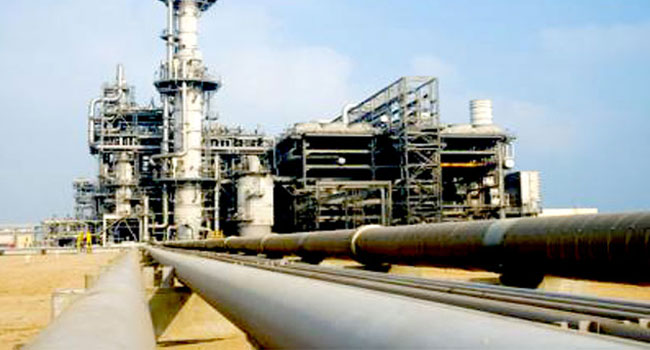
The Nigerian Midstream and Downstream Petroleum Regulatory Authority (NMDPRA) has disclosed that Nigeria plans to channel all of its crude oil production to domestic refineries by 2030 as the country expands its local refining capacity.
According to a report by S&P Global, Nigeria produced about 1.74 million barrels of crude oil per day in June and is targeting production of three million barrels daily by 2030.

The report noted that Nigeria has traditionally exported most of its crude to refineries in Europe and Asia but is increasingly prioritising domestic refining as part of efforts to improve energy security and increase national revenue.
The NMDPRA told the publication that Nigeria’s current domestic refining capacity is approximately 1.12 million barrels per day.
The authority also disclosed that it was working with the Nigerian Upstream Petroleum Regulatory Commission (NUPRC) to enforce provisions requiring local crude producers to supply refineries within the country.
NMDPRA Chief Executive Officer, Rabiu Umar, said the Dangote Refinery was contributing significantly to the expansion of domestic refining capacity, particularly with its planned increase in processing capacity to 1.4 million barrels per day.
Umar said the authority was working to address crude supply challenges confronting local refineries while ensuring compliance with the Domestic Crude Supply Obligations (DCSO) contained in the Petroleum Industry Act (PIA).
“The Federal Government wishes to end the pattern where much of the country’s crude [volumes] are exported and refined products imported,” Umar said.
“We are engaging the Nigerian Upstream Petroleum Regulatory Commission to ensure that every molecule of our 3 million b/d that we hope to achieve in the coming years is refined locally.”
Data from the NUPRC published on August 10 showed that domestic refineries received 53.7 million barrels of Nigerian crude in the second quarter of 2026.
The Dangote Refinery accounted for 52.6 million barrels of the total volume supplied.
The upstream regulator, however, said the Dangote refinery had been offered 68.1 million barrels, a quantity that would have fully satisfied its crude requirements.
Dangote refinery’s crude supply needs
According to the report, the Dangote Refinery, which supplies as much as 90 per cent of Nigeria’s refined petroleum products, has previously identified access to adequate and reliable crude supplies as one of the challenges affecting its operations.
The refinery has consequently sourced crude from international markets to support its operations and expansion plans.
“The state-run Nigerian National Petroleum Co. was originally meant to supply the majority of its crude, but was restricted upon the launch of the refinery in 2024 by its forward selling,” S&P Global said.
“The PIA, which took effect in 2021, empowers the NUPRC to impose DCSOs on upstream operators and licensees and to mandate that a specified percentage of their produced crude and condensate be allocated for local sale.”
A spokesperson for the NUPRC also confirmed to Platts, S&P Global Energy’s pricing and news platform, that discussions were ongoing with relevant government agencies regarding enforcement of the domestic crude supply requirement.
“We have been holding meetings involving the NMDPRA, Ministry of Finance, and crude suppliers on the enforcement of this provision of the law,” the NUPRC spokesperson said.
In May, the NUPRC disclosed that upstream producers had offered 68.7 million barrels of crude oil to domestic refineries during the first quarter of 2026 but ultimately supplied less than half of the volume.
The commission attributed the shortfall between the quantity of crude offered and the amount actually delivered to differences in pricing expectations between producers and domestic refiners.