

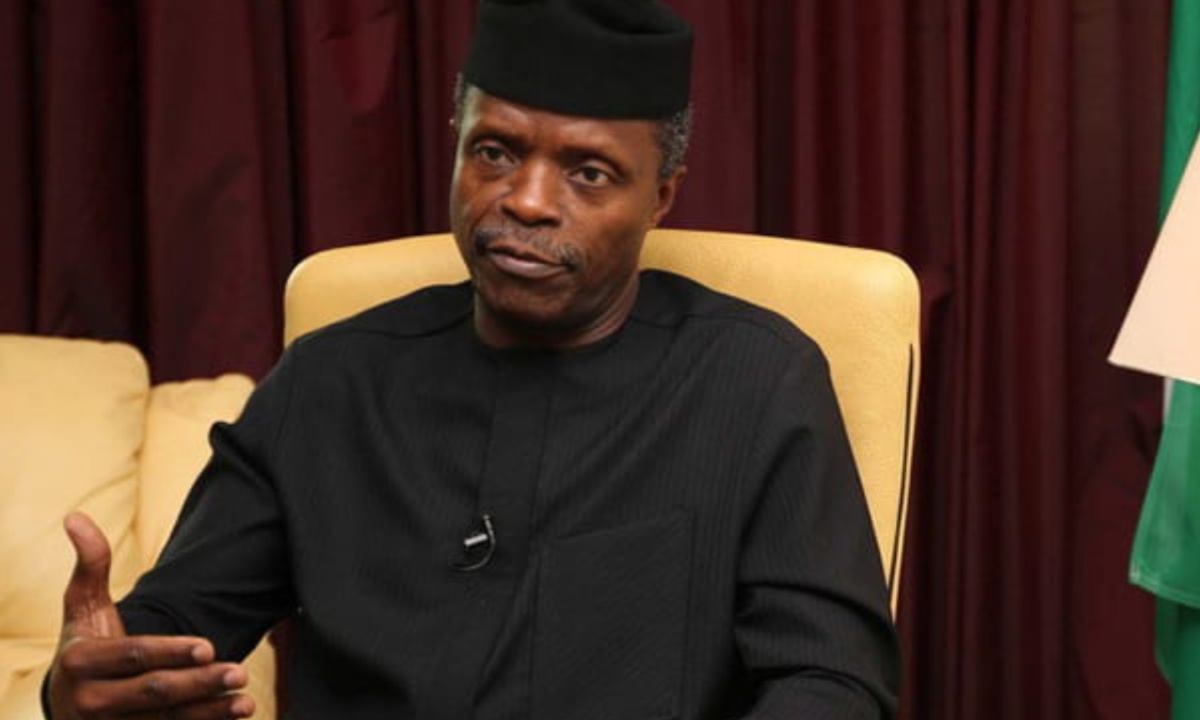
Former Vice President Yemi Osinbajo has advocated for a profound transformation of Nigeria’s legal and judicial mindset, particularly the trend of courts prioritising technicalities over genuine justice.
Speaking in Ilorin, Kwara State, at the second Prof. Yusuf Ali’s Annual Lecture hosted by Kwara State University (KWASU), Malete, the law professor emphasised that the true purpose of any justice system should be to serve the people rather than uphold rigid procedural rules.

He expressed concern that many court rulings, including those from the Supreme Court, tend to focus more on procedural form than on the substance of justice.
He stated, “Even English courts, whose practices we inherited, have evolved beyond such rigid technicalities by allowing amendments at any stage to ensure justice is done.”
According to him, Nigeria’s persistent reliance on outdated procedural barriers weakens justice delivery and diminishes public confidence in the judiciary.
He urged members of the legal community—practitioners, scholars, and policymakers—to embrace critical and decolonised thinking to reform legal education, practice, and justice administration.
He added, “Though the Supreme Court has occasionally adopted a more flexible approach, particularly in electoral matters, inconsistency remains a major concern.
“It is important to note that a justice system that glorifies form over substance risks losing its relevance and effectiveness,” he said.
Guest lecturer Prof. Chidi Odinkalu (SAN) encouraged Nigerian legal professionals and students to actively dismantle the colonial influences still embedded in the nation’s legal structures.
Speaking on the theme Towards Decolonising Legal Briefs: Effective Implementation of the Local Content Law for the Benefit of Nigerian Lawyers, Odinkalu noted that despite political independence, Nigeria remains intellectually and structurally dependent.
He emphasised that although the country is politically sovereign, true occupational and ideological independence is still lacking.
Odinkalu called for an independent and credible judiciary as a cornerstone of the decolonisation process.
KWASU Vice Chancellor, Prof. Jimoh Shaykh-Luqman, expressed appreciation for the development recorded in the university’s Faculty of Law and revealed that key infrastructure—including a departmental building, a 500-seat auditorium, and two 250-seat lecture theatres—would be completed by December.
Prof. Yusuf Ali noted that every nation needs a unifying point, adding that Nigeria currently lacks such cohesion.
He observed that the only moments Nigerians appear truly united are during international football events—brief episodes of unity that quickly fade afterwards.
He urged citizens to face the harsh realities of systemic dysfunction rather than romanticising the past, stressing that the country still displays clear indicators of institutional failure.