

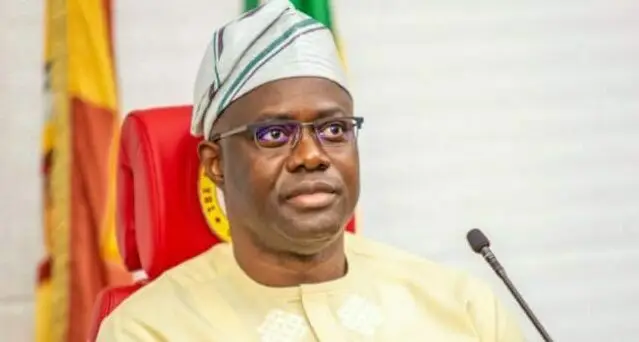
The Governor of Oyo State, Mr. Seyi Makinde, has blamed Nigeria’s political elite for the persistent disunity and divisions within the country.
Makinde made the remark on Wednesday in Abuja during the public presentation of a book titled “Headlines and Soundbites: Media Moments that Defined an Administration,” authored by former Minister of Information and Culture, Alhaji Lai Mohammed.

‘Help save my life, I’ve lost both breasts to cancer’ – Grandmother Nelson Joyce cries out0:00 / 0:00
The governor cautioned that infighting among the political class continues to weaken national cohesion and hinder progress. He observed that everyday Nigerians, regardless of background, largely agree on the need to remain united as one nation.
According to him, it is the elite class that frequently exploits ethnic, religious and regional differences in pursuit of political ambition.
Makinde therefore called for what he described as an “elite consensus” on Nigeria’s future, urging leaders across party lines to clearly identify the country’s current challenges and develop solutions that reflect present-day realities.
“My experience is that ordinary Nigerians already have a consensus that they want to be Nigerians. But we the elites are the ones dividing the country because of our ambition.
“Oh, he’s a Muslim, he’s Christian, he’s a South-South, he’s Yoruba.
“We need elite consensus on how to move forward,” he said.
The governor also stressed the need for comprehensive political reforms as a pathway to national development.
Although he is not a member of the ruling All Progressives Congress (APC), Makinde said his attendance at the event highlighted the importance of national engagement beyond partisan considerations. He also reiterated that he had no intention of defecting to the APC.
While congratulating Mohammed on the book, Makinde encouraged public office holders to document their experiences in governance to enrich Nigeria’s historical records.
“Our leaders should enrich our history by documenting how they saw events from their own perspectives.
“It gives future generations something to interrogate, critique and learn from,” he said.
He recalled his interactions with the late President Muhammadu Buhari, including their time as candidates under the All Nigeria Peoples Party (ANPP) during the 2007 elections, noting how political journeys often evolve.
Reflecting on Nigeria’s federal structure, Makinde said the challenges confronting the nation today differ significantly from those that followed the civil war, when national unity was the primary concern.
“Of course, federalism and multi-party democracy were settled for in that negotiations.
“I’ve had the opportunity to discuss with some of our leaders that were players in that period, and they said, well, the only problem they were faced with as of that time was that they went through a civil war, and they needed to unite Nigeria.
“Their major task was to unite Nigeria and that was why they agreed on federalism.
“But, is it the same problem that we’re faced with today? The answer is no.
“So we must identify the problems that we are faced with today and design something that will allow us to tackle that problem,” he said.
Earlier at the event, former Head of the Civil Service of the Federation, Prof. Oladapo Afolabi, called for credible elections and constitutional reforms, warning that weak democratic processes could lead to instability.
Afolabi advocated reforms such as ending the winner-takes-all system, decentralising governance, strengthening institutions, upholding the rule of law and considering a single-term tenure for executive positions.
The News Agency of Nigeria reported that the book launch drew political leaders, academics, media professionals and members of the public from across the country.
