

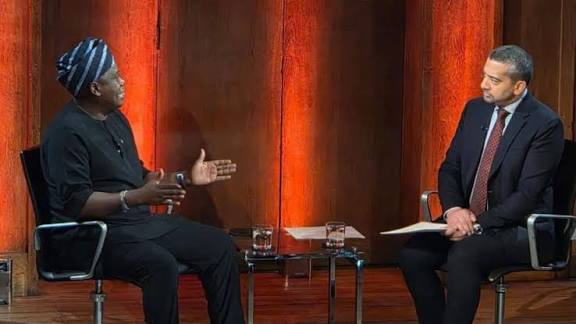
A chieftain of the Peoples Democratic Party (PDP), Segun Showunmi, has criticised Mehdi Hasan of Al Jazeera for subjecting Daniel Bwala, special adviser to President Bola Ahmed Tinubu on media and policy communication, to what he described as “hostility” and public ridicule during a recent Head to Head interview.
Bwala appeared on the programme on Thursday, where he responded to questions regarding the Nigerian government’s policies and some of his earlier comments about the president.

During the discussion, Hasan confronted the presidential aide with past quotes, video clips and statements from the period when Bwala was in the opposition and aligned with the presidential campaign of former Vice-President Atiku Abubakar.
Hasan referenced several past remarks critical of Tinubu, prompting Bwala to deny some of the statements attributed to him.
The interviewer also questioned Tinubu’s anti-corruption credentials, citing the appointment of Abubakar Bagudu, minister of budget and economic planning, whom he noted had previously been indicted by the US Department of Justice (DOJ) over corruption allegations.
Clips from the interview quickly circulated on social media on Saturday, sparking widespread reactions online.
Responding to the debate in a statement, Bwala defended his performance, explaining that his earlier comments about President Tinubu were “all politics” and should be interpreted within that context.
He also criticised Hasan’s questioning style, alleging that some quotes attributed to organisations and groups during the interview were inaccurate.
‘Hostility is not journalism’
In a statement released on Sunday, Showunmi defended the presidential aide and condemned what he described as Hasan’s “hostile” approach during the interview.
“There is a clear difference between tough journalism and outright hostility. One serves the public interest. The other serves the ego of the interviewer. Unfortunately, the recent exchange between @mehdirhasan and presidential spokesperson @BwalaDaniel fell squarely into the latter category,” Showunmi said.
He described the conversation as “not a serious interview,” but rather “an attempted public ambush,” carried out in what he termed an “aggressively confrontational” manner.
“Questions were framed less as inquiries into governance and more as prosecutorial traps. Responses were repeatedly interrupted before they could develop. Clarifications were brushed aside.
“The atmosphere was unmistakable: this was not a conversation designed to inform viewers but a spectacle designed to embarrass the guest,” the PDP chieftain added.
Showunmi noted that proper interviewing requires discipline and the ability to ask difficult questions while still giving guests the opportunity to present their views.
“It requires intellectual confidence strong enough to permit disagreement without descending into open hostility. Above all, it requires a commitment to substance over theatrics. That commitment was glaringly absent,” he said.
He further argued that, considering Nigeria’s present “serious national challenges, economic threats, governance reforms” and ongoing stability concerns, Hasan should have focused more on examining the administration’s policies and plans for citizens.
“Instead, viewers were treated to an exercise in selective outrage and repetitive interruption. But the deeper problem in the interview was tone,” Showunmi stated.
‘Ridiculing a guest crosses professional boundary’
Showunmi added that journalists cross an important professional line when they ridicule or attempt to humiliate their guests.
“The role of the interviewer is to hold power accountable, not to behave like a courtroom prosecutor seeking a viral ‘gotcha’ moment,” he said.
“When the pursuit of humiliation replaces the pursuit of insight, journalism loses its credibility. Audiences deserve better than that. They deserve interviews that illuminate policy, probe governance, and help citizens understand how leaders intend to confront the pressing challenges of the day. What they do not need is a theatrical performance in which hostility is mistaken for intellectual rigor.”
He also maintained that respectful engagement strengthens journalism rather than weakens it, adding that tough questions can be asked without contempt or aggression.
“If global media wishes to retain its claim to moral authority as a watchdog of democracy, it must remember a basic principle: the goal of journalism is to inform the public, not to stage spectacles at the expense of civility and substance,” he said, adding that the Al Jazeera interview failed to reflect fearless journalism.
Showunmi also cautioned against portraying political realignment as improper, stressing that shifting alliances are a normal part of democratic politics.
“Former opponents become partners when national circumstances demand cooperation. It is neither shocking nor dishonorable, but the defining characteristic of democratic political life,” Showunmi said.
“History provides countless examples where leaders worldwide have entered alliances with former adversaries to meet governance needs. To pretend otherwise is either intellectual dishonesty or a deliberate attempt to create sensationalism where none exists.”