

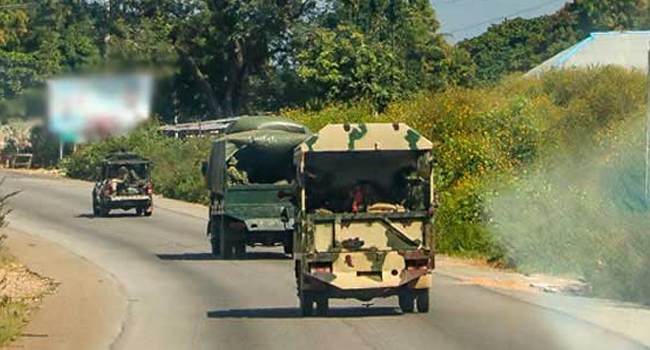
As part of efforts to address rising insecurity in parts of the country, the Senate has urged the enhancement of the joint security operation in Niger and Kwara states.
The upper chamber directed its Committees on Defence, Army, Air Force, Police Affairs, and National Security and Intelligence to jointly evaluate the security situation in the North-Central region and present a detailed report with recommendations within four weeks.

The resolution followed a motion moved by Sani Musa (APC/Niger East) after the killing of more than 50 people and the abduction of several women and children in Konkoso District, Borgu Local Government Area of Niger State.
In his submission, Musa lamented that the North-Central region has continued to experience coordinated assaults on rural communities, farms, and settlements, posing serious threats to food security and national stability.
Lawmakers also expressed concern that the repeated attacks on remote communities point to lapses in intelligence coordination and have worsened the humanitarian situation in the area.
The Senate, after observing a minute of silence in honour of the victims, called for strengthened collaboration between Niger and Kwara states to dismantle cross-border terrorist networks.
‘Violence’
Last Saturday, gunmen riding motorcycles invaded three villages in central Nigeria, killing at least 46 people.
The renewed violence has once again drawn attention to Nigeria’s struggle to curb security challenges — efforts that have faced criticism from US President Donald Trump.
A security report obtained by AFP indicated that the attackers used “41 motorcycles, each carrying two or three men”.
The affected villages are located in Borgu, Niger State, near the border with Kwara State, where jihadists had earlier killed over 160 people this month.
The deadliest incident occurred in Konkoso village, where at least 38 people were reportedly killed, according to a humanitarian source who spoke anonymously to AFP.
Many houses in the village were set ablaze, and additional bodies were still being recovered, the source said.
A resident of Konkoso told AFP that the attackers first struck the nearby village of Tungar Makeri before advancing to his community.
A spokesperson for the Niger State Police Command confirmed to AFP that six people were killed in Tungan Makeri when gunmen stormed the village at about 6:00 am.
Fears Death Toll Could Rise
“Some houses were set on fire, and an as-yet undetermined number of people were abducted,” the police spokesman said, adding that investigations were ongoing regarding the other affected villages.
The Konkoso resident said his nephew was among the victims.
“They burned a lot of houses and abducted four women,” he said.
“After Konkoso, they went to Pissa, where they set a police station on fire and killed one person.
“At the moment, many people are missing,” he added.
The boundary between Kwara and Niger states includes the Kainji Forest, known as a hideout for bandits and jihadist groups.
Nigeria has battled a jihadist insurgency in the northeast for more than 16 years.
In addition, the country faces farmer-herder clashes in the north-central region, separatist violence in the southeast, and widespread kidnapping for ransom in the northwest.
Jihadist factions have expanded activities into the northwest and west-central regions, taking advantage of instability in neighbouring Niger and Burkina Faso.
Armed groups commonly referred to as “bandits” have also intensified attacks, raiding villages, killing residents, and carrying out kidnappings.
Earlier in February, jihadists killed over 160 people in Woro village in Kwara State.
The al-Qaeda-linked Group for the Support of Islam and Muslims (JNIM) claimed responsibility for its first attack on Nigerian territory near Woro last October.
Religious and community leaders in Borgu recently appealed to President Bola Tinubu to establish a military base in the area to curb the repeated assaults.
On December 25, the US military coordinated with Nigerian authorities to conduct airstrikes in Sokoto State, targeting what Washington described as Islamic State jihadists.
Trump had alleged that Christians in Nigeria were being “persecuted” and victims of a “genocide” carried out by “terrorists”.
However, the President Bola Tinubu administration dismissed the claim, maintaining that the violence affects both Christians and Muslims indiscriminately.