

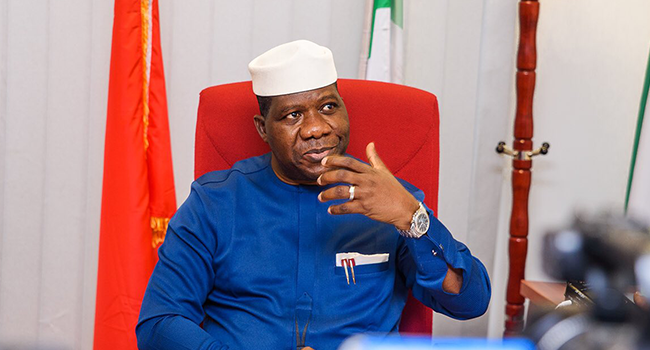
Senate Majority Leader Opeyemi Bamidele has warned that the proposed state police system could fail if it is not backed by adequate funding and financial independence.
Speaking at the ARISE NEWS Townhall on State Police on Thursday, Bamidele said a poorly funded state police structure would be vulnerable to manipulation by politicians, wealthy individuals, businesses and criminal groups, ultimately undermining its ability to provide security.
“If the state police is not well funded, it may as well be a highway to nowhere,” he said.

Bamidele explained that the constitutional amendment before the National Assembly is not intended to compel every state to establish its own police force immediately. Instead, it seeks to provide the legal framework by moving policing from the Exclusive Legislative List to the Concurrent Legislative List, allowing states to create their own police services if they choose.
“It’s not every state that will immediately, after we finish amending this constitution, go to town to say, ‘We’re launching our state police.’ All we are trying to achieve with this constitutional amendment is to move this duty from the exclusive legislative list to the concurrent legislative list,” he stated.
The senator acknowledged widespread concerns about the potential misuse of state police, describing them as legitimate and deserving of careful attention.
“The various concerns that have been expressed from different quarters are well-founded concerns that we cannot sweep under the carpet or pretend that they are not real,” he said.
According to Bamidele, accountability must be reinforced through strong legislation and sustained oversight by citizens and civil society organisations.
“When it comes to issues of accountability, it’s something that will have to be addressed, both at the level of legislative intervention, through the law, as well as vigilance on the part of the Nigerian people,” he added.
He further cautioned that the threat of undue influence extends beyond elected officials, warning that inadequate funding could leave state police susceptible to private interests and criminal elements.
“It’s not only state actors or politicians that can abuse this. Business class, some other organisations, even criminals can abuse it, because he who pays the piper dictates the tune,” Bamidele said.
To safeguard the proposed policing system, he advocated constitutional and legal provisions guaranteeing a stable source of funding independent of governors’ discretion. He suggested earmarking a fixed percentage of state budgets for policing, with clear rules governing the management and disbursement of the funds.
“We must have a situation where there will be some first-line provisions in our law. The police chief and the police service commission must have a guaranteed source of income in a way that it will not be subject to the whims and caprices of a sitting governor,” he said.
Bamidele also stressed that constitutional amendments alone would not be sufficient, noting that further reforms to the Police Act and other relevant laws would be necessary to define the structure, operations and coordination of state police with existing security agencies.
“We must see beyond constitutional amendment, because once the constitution has been amended, what is next?” he asked.
He added that lawmakers must also determine the future role of existing paramilitary organisations within the proposed security framework.
“Also, we must address what becomes of the other organisations, especially including paramilitary organisations that were created for the purpose of helping to maintain law and order,” he said.
The Senate leader maintained that the primary objective of state police is to strengthen community policing and improve security at the grassroots level. However, he argued that the initiative would deliver limited results without genuine local government autonomy.
“The whole essence of trying to emphasise on the move for state policing is because we want community policing. If we do not address the issue of local government autonomy, we will not have achieved much, even with the creation of state police,” he said.
Bamidele noted that the National Assembly has studied international best practices while developing minimum national standards for state policing. He concluded that Nigeria has reached a stage where state police has become necessary, but insisted that its implementation must be supported by strong laws, sustainable funding and effective safeguards against abuse.
“We are at a stage now where we must bring this to reality,” he said.
