

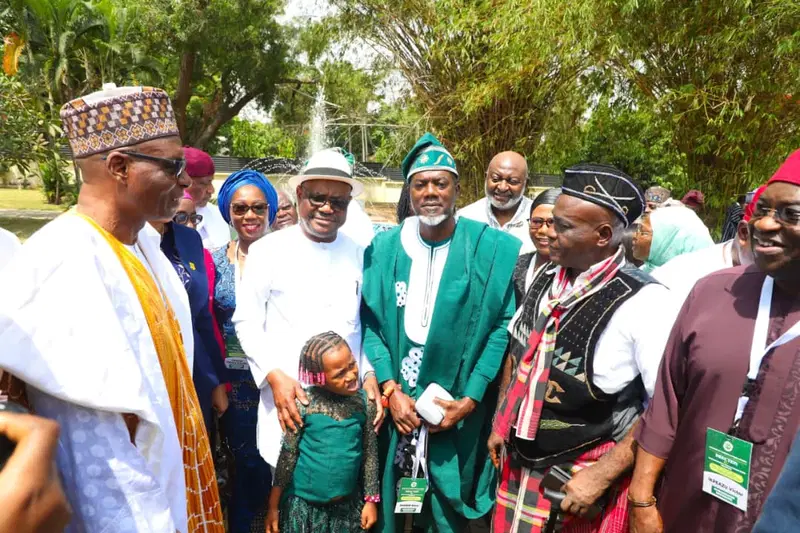
The president Bola Tinubu has authorised the distribution of plots of land to Nigerian ambassadors and high commissioners-designate in Abuja, a move revealed on Wednesday by the Federal Capital Territory minister, Nyesom Wike.
Wike shared this update while hosting the envoys during a courtesy visit at his official residence in Life Camp, Abuja.

The group, led by the Permanent Secretary of the Ministry of Foreign Affairs, Dunoma Umar Ahmed, visited as part of an induction programme for the newly appointed diplomats.
According to the minister, the president’s move aims to ensure Nigeria’s foreign representatives have a permanent base in the capital whenever they return for periodic briefings.
“The President believes that most of you do not have a place in Abuja… he will encourage you to see how you will put up where you can stay. Before you leave this morning, each and every one of you should have your form to apply for a land allocation in Abuja,” Wike said.
In addition to the land allocation, Wike urged the envoys to uphold and promote Nigeria’s image internationally. “You are, in essence, the mirror of this country. The way the world sees you is the way it will see Nigeria,” he said.
He further encouraged them to support the economic diplomacy initiatives spearheaded by President Tinubu through his numerous foreign trips.
The minister explained that the president has travelled widely to draw in investment and partnerships, and emphasised that it is now the diplomats’ duty to build trust in Nigeria as an attractive investment destination.
Addressing concerns about the country’s democracy, Wike stated, “Nigeria remains a multi-party democracy. There is no plan to turn the country into a one-party state. You must communicate this clearly wherever you serve,” he said.
He also highlighted growth prospects within the Federal Capital Territory, noting ongoing infrastructure development across the six area councils—Abaji, AMAC, Bwari, Gwagwalada, Kuje, and Kwali—as signs of Abuja’s rising profile as an international capital.
