

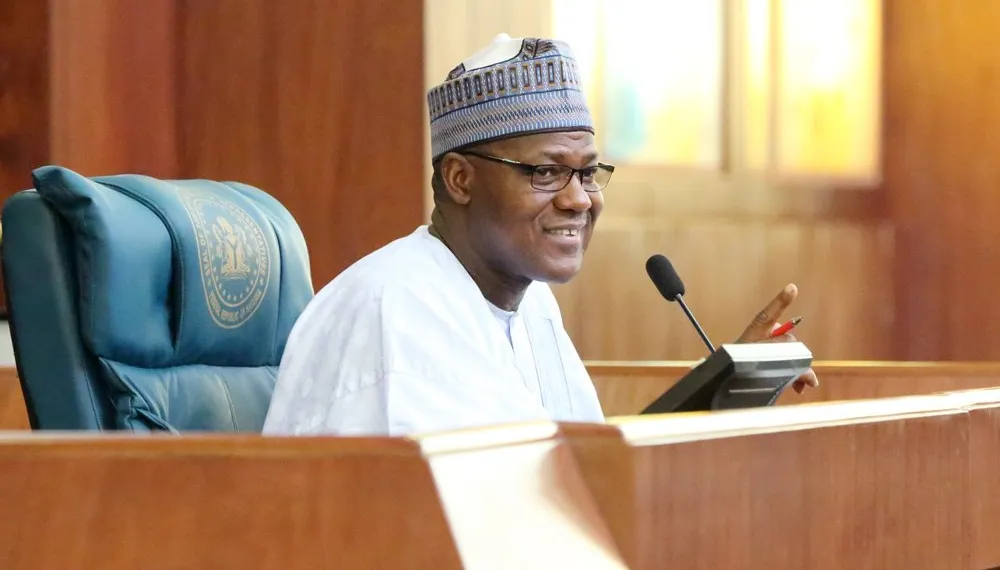
Former Speaker of the House of Representatives, Yakubu Dogara, has described President Bola Ahmed Tinubu’s economic reform programme as a revolution and the boldest in Nigeria’s history in decades.
Dogara said the President inherited a failing economy that required “bold and courageous” actions to avert collapse.

Upon assuming office on May 29, 2023, Tinubu removed petrol subsidy and scrapped multiple exchange rates—two defining policies of his administration.
Dogara noted: “This is a legacy that would impact generations after us and cement President Tinubu’s place in Nigeria’s history as the undisputed most consequential economic reformer of our time.”
He made these remarks at the maiden Distinguished Parliamentarian Lecture organised by the House of Representatives Press Corps at the National Assembly Complex in Abuja.
Delivering his lecture titled “Navigating Tax Reform in Nigeria: Insights on President Tinubu’s Policies,” Dogara examined the origins, scope, and potential impact of the new tax framework under the Nigeria Tax Act (NTA) 2025 and other related legislation.
Dogara explained that by the time Tinubu assumed office, the nation’s economy was already in deep crisis:
“About N22.7 trillion had been printed and injected into the economy in the name of Ways and Means, thereby destroying the value of the naira in our pockets.”
He also criticised past economic policies: “Some of the foreign loans had been procured to help strengthen the naira, a measure that could only be sustained by voodoo economics.”
According to him, “From day one, it was clear something urgent, nay revolutionary, must be done to prevent our economy from imploding.”
Dogara hailed Tinubu’s tax reforms as the most ambitious restructuring of Nigeria’s fiscal system in decades, stressing the need for transparency and consistent implementation to win public trust.
The reforms consolidate 16 federal tax statutes into four principal Acts:
Nigeria Tax Act (NTA) 2025: merges multiple tax laws, expands the tax base to digital services and virtual currencies, and introduces a 15% minimum effective tax rate for large corporations.
Nigeria Tax Administration Act (NTAA) 2025: modernises compliance rules, mandates unified Taxpayer IDs, introduces simplified filing for low-income earners, and creates a Tax Ombudsman’s Office.
Nigeria Revenue Service (Establishment) Act (NRSEA) 2025: replaces the FIRS with the Nigeria Revenue Service, with wider powers and mandatory transparency reporting.
Joint Revenue Board (Establishment) Act (JRBEA) 2025: harmonises federal-state revenue sharing and manages disputes through a Tax Appeal Tribunal and Ombudsman.
The former Speaker said the reforms, effective from January, are intended to simplify tax administration, broaden the base, align with global standards, and ensure fairness.
Quoting the report of the Presidential Committee on Fiscal Policy and Tax Reform chaired by Taiwo Oyedele, Dogara said the reforms aim to “protect the poor, empower businesses, encourage investment, and ensure fairness in society.”
Among the reliefs introduced are exemptions for small businesses with turnover below N100 million, rent reliefs for salaried workers, tax credits for oil operators, and income tax exemption for individuals earning N800,000 or less annually.
The reforms also replace multiple levies with a single 4% development levy, while taxing digital assets, crypto gains, and forex earnings.
Dogara clarified that the 5% fuel surcharge is not a new tax but a provision under the FERMA Act 2007, stressing it will exclude kerosene, cooking gas, and CNG, and only take effect after the Finance Minister issues a gazette.
He warned of short-term challenges, including interpretation issues, digital readiness, skilled manpower gaps, and compliance costs.
According to him, “True tax reform is not about raising rates, but about raising trust. When citizens can see where their naira goes, they are proud to give it.”
Dogara urged the government to transparently deploy tax revenues into infrastructure, healthcare, and education.
“Let this reform be a pact between the government and the private sector, a promise that if we contribute diligently, the government will deploy those resources responsibly,” he added.
Speaker of the House of Representatives, Tajudeen Abbas, also praised the reforms, calling them a decisive step toward simplification, fairness, and transparency. Represented by House Spokesperson Akin Rotimi, Abbas described them as “a significant intervention that promises to re-engineer our tax administration architecture for greater efficiency, fairness, and transparency.”
He emphasised that the 10th House is committed to openness, transparency, and citizen engagement, highlighting innovations such as live streaming, digital portals, and community consultations. Abbas also reaffirmed support for press freedom, calling it non-negotiable.
The Federal Inland Revenue Service (FIRS), represented by Olufemi Olarinde on behalf of Chairman Zacch Adedeji, also stressed the role of the media in communicating reforms effectively.
Olarinde said: “In Latin, we say nemo dat quod non habet, you cannot give what you do not have. If we must speak and enlighten the public about these reforms, then it is important we first understand them ourselves.”