

In Offa, Kwara State, solving complex mathematical equations has become a regular activity in the Muritala family home, where nine-year-old Charlotte Muritala is turning her passion for numbers into lessons for thousands of children online.
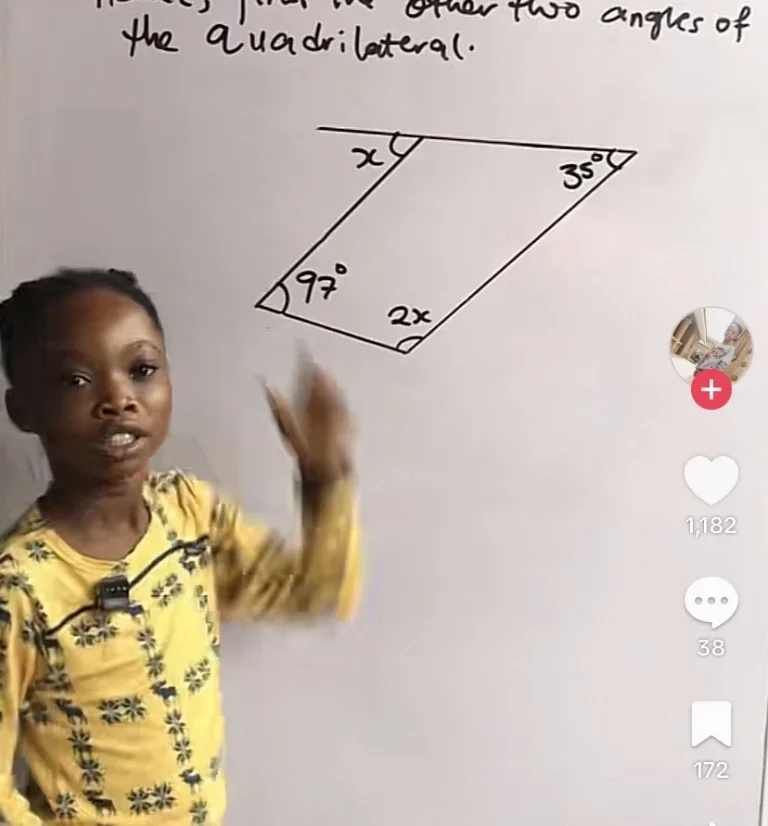
A JSS2 student of Iyeru Okin African Church Secondary School, Offa, Charlotte teaches mathematics on TikTok using a whiteboard, marker and smartphone, breaking down topics such as algebra and simultaneous equations into simple, step-by-step lessons.

For the young mathematics enthusiast, her love for numbers started long before she entered secondary school.
“I started liking mathematics when I was small because I enjoyed numbers and playing puzzles,” Charlotte said.
“Mathematics is fun for me. Some questions are hard, but I like trying to solve them.”
Charlotte said her approach to difficult mathematical problems is to break them into smaller parts and solve them one step at a time.
“First, I break it into smaller parts to make it easier for me. If I’m not getting it at first, I choose the best method and solve it step by step,” she explained.
With the support of her parents, Charlotte has also transformed social media from a platform primarily associated with entertainment into an informal classroom where she shares what she knows with other children.
“My mom created the platform for me to share what I know with other children. I feel very happy and proud of myself,” she said.

Her father, Afeez Muritala, described Charlotte as a dedicated learner who remains a child despite her unusual academic abilities.
“She’s always learning and reading,” he said. “Apart from school, she has a lesson teacher, and sometimes when I have the chance, I teach her too.
“But she is still nine years old. Sometimes she plays, but when it comes to reading, she doesn’t joke with it.”
Charlotte’s mathematics teacher, Kolawole Oluwasegun, also described her as an exceptional student with a strong ability to solve mathematical problems.
“Charlotte is an astute student with exceptional skills in mathematics,” Oluwasegun said. “She has a genuine passion for solving any mathematical problem. In a nutshell, she is excellent.”
The teacher, however, said more needed to be done to encourage interest in mathematics among Nigerian children.
According to him, schools need qualified teachers, scholarships and adequate funding, while mathematics competitions should be organised with rewards that encourage all participants rather than only the top performers.
Charlotte’s influence also extends beyond her online lessons, as she continues to encourage classmates and other young learners to approach mathematics with confidence.
For children who struggle with the subject, her message is simple: persistence is more important than getting every answer right on the first attempt.
“My advice to them is to never give up. They should keep practising every day and not be afraid of making mistakes,” she said.
Through her short, practical tutorials, Charlotte is showing that mathematics does not have to be intimidating. For the nine-year-old, every difficult equation is simply another puzzle waiting to be solved.