

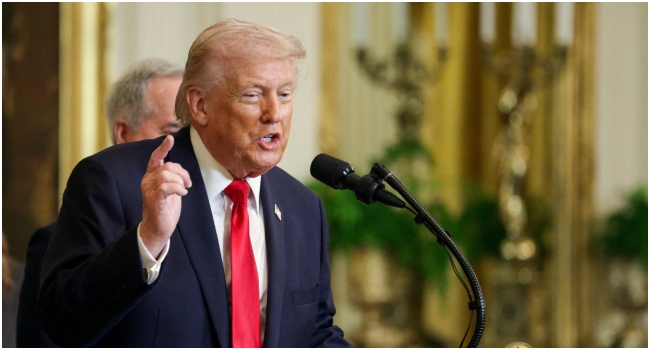
On Saturday, Donald Trump urged other nations to deploy naval vessels to help secure the Strait of Hormuz, a crucial route for global oil shipments currently disrupted by tensions stemming from the Middle East conflict.
The US president suggested that several countries could join the United States in efforts to keep the waterway open for international shipping.

Posting on the social platform Truth Social, Trump said, “Many countries, especially those who are affected by Iran’s attempted closure of the Hormuz Strait, will be sending War Ships, in conjunction with the United States of America, to keep the Strait open and safe.”
He further noted that major global economies impacted by the disruption should participate in the operation.
“Hopefully China, France, Japan, South Korea, the UK, and others, that are affected by this artificial constraint, will send Ships to the area,” he added.
Also on Saturday, the White House reiterated the president’s position in a noon post on X, stating: “One way or the other, we will soon get the Hormuz Strait OPEN, SAFE, and FREE!” – President DONALD J. TRUMP.
Strait of Hormuz
The Strait of Hormuz is one of the world’s most vital energy chokepoints, handling a significant portion of global oil shipments.
The recent tensions are part of a broader Middle East conflict involving Iran, Israel, and the United States, which escalated after joint US–Israeli strikes on Iranian military targets in late February.
Since then, Iran has carried out retaliatory missile and drone attacks across the region and threatened shipping in the Strait of Hormuz, raising concerns of a larger regional war and potential global economic consequences.
This strategic waterway has become the focal point of the crisis because it is critical for global energy transport. Over 20 million barrels of oil pass through the strait daily — roughly a fifth of global consumption, according to Reuters — and disruptions have already caused a sharp rise in oil prices due to fears of prolonged supply shortages.
The conflict has also affected shipping and trade in the Gulf. Tankers have been attacked, maritime traffic disrupted, and analysts warn that a continued blockade could have “catastrophic consequences” for global energy markets and the wider economy.
