

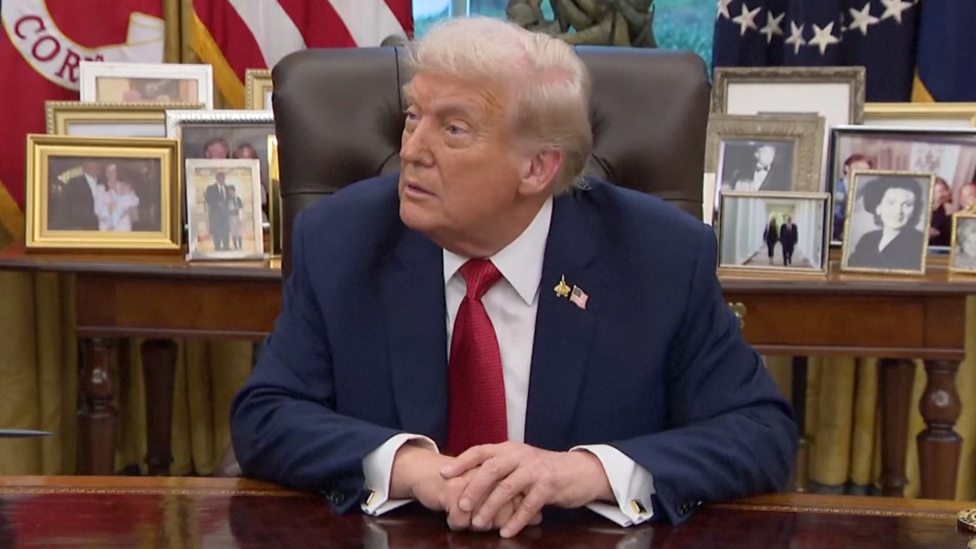
US President Donald Trump has signed an executive order seeking to rename the 370-year-old Lake Ontario as “Lake America”, adding an unusual dimension to growing trade tensions between the United States and Canada.
Lake Ontario is one of North America’s five Great Lakes and lies along the Canada-US border, with the Canadian province of Ontario to its north and New York State to its south.

The Great Lakes — Huron, Ontario, Michigan, Erie and Superior — collectively contain about one-fifth of the world’s surface freshwater.
The name Lake Ontario has been used for centuries, with its earliest known appearance on a map dating back to 1656, although historians say the name was already in use among local communities before then.
Trump announced the proposed change on Thursday after signing the order in the Oval Office.
“This is official, effective immediately,” Trump said.
He also said he had “filed all the necessary papers, documents, everything else” relating to the change and had “notified all of the various people that we have to notify”.
According to the executive order, “the deepest parts of the Lake’s waters lying within United States territory, the United States claims most of the Lake’s volume”. It also described the lake as having “long been an integral asset to American exploration, settlement, commerce, and defense”.
However, the extent to which the new name will be recognised outside the United States remains unclear, as there is no single global authority responsible for geographical names.
History of Lake Ontario
Lake Ontario is a post-glacial lake that formed from Lake Iroquois approximately 11,400 years ago.
By the mid-18th century, before the American Revolution and the eventual establishment of Canada and the United States, Lake Ontario had become the widely established name for the body of water.
The name Ontario is believed to have Iroquoian origins and is commonly interpreted as meaning “beautiful lake” or “sparkling water”, although some historians have also associated it with the phrase “vast body of water”.
French missionary records from around 1641 also referred to the body of water as Lake Ontario. The Canadian province of Ontario, established at Confederation in 1867, later adopted its name from the lake.
Canadian Industry Minister Mélanie Joly had earlier rejected the prospect of a name change, saying: “We’ll always call it Lake Ontario”.
Trump’s latest move echoes his decision last year to rename the Gulf of Mexico as the Gulf of America.
“We have a gulf and we have a lake. Now all we need is an ocean so maybe we’ll have to change the name of the Atlantic and/or the Pacific,” Trump said.
The latest announcement comes amid worsening relations between Washington and Ottawa following the collapse of trade talks late last Friday and the introduction of 50 per cent tariffs on billions of dollars’ worth of Canadian exports.