

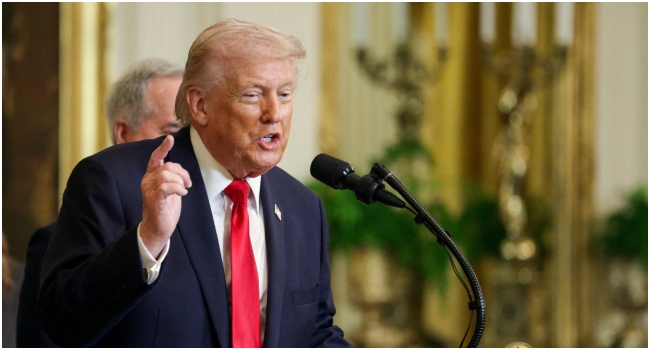
US President Donald Trump has said he is dispatching a delegation to Pakistan on Monday for negotiations with Iran, while renewing threats to target the country’s key infrastructure if it refuses to reach an agreement.
“NO MORE MR. NICE GUY!” the American leader declared on Sunday in a post on his Truth Social account, warning that without a deal, Washington was “going to knock out every single Power Plant, and every single Bridge, in Iran”

Iran, the United States, and Israel are approaching the end of a two-week ceasefire that paused the Middle East conflict triggered by US-Israeli strikes on Iran on February 28.
So far, only one 21-hour negotiating session has taken place in Islamabad on April 11, ending without agreement, though efforts to prepare for further talks have continued.“We’re offering a very fair and reasonable DEAL, and I hope they take it,” Trump added.
No date has been set for a second round of discussions, while Iran’s parliament speaker and senior negotiator Mohammad Bagher Ghalibaf said on Saturday that both sides remain “still far from the final discussion”.
Trump has justified the conflict as an effort to prevent Tehran from acquiring nuclear weapons—an objective Iran has consistently denied—leaving the issue at the centre of negotiations.
Prior to the conflict, Iran and the US had been engaged in Oman-mediated talks over Tehran’s nuclear programme. The war has since introduced an additional point of contention: the Strait of Hormuz, a critical route for global oil and gas shipments, which Iran has ordered shut.
Advertisement
Heightened security
Security has been tightened in Islamabad ahead of the anticipated talks, with road closures and traffic restrictions imposed across the city and neighbouring Rawalpindi.
Journalists reported the presence of armed personnel and checkpoints around key locations, including major hotels such as the Marriott and the Serena.
Authorities urged residents to cooperate with security agencies as preparations continue.
Trump said his negotiators, whose identities were not disclosed, would arrive in the Pakistani capital on Monday evening. The previous delegation was led by Vice President JD Vance and included Middle East envoy Steve Witkoff.
A key obstacle in negotiations remains Iran’s stockpile of near-weapons-grade enriched uranium.
Trump claimed on Friday that Iran had agreed to hand over approximately 440 kilogrammes of enriched uranium, stating: “We’re going to get it by going in with Iran, with lots of excavators.”
However, Iran’s foreign ministry rejected the claim, insisting the stockpile would not be transferred and that such a proposal had never been part of discussions.
On Sunday, President Masoud Pezeshkian questioned why Iran should relinquish its “legal right” to a nuclear programme.
Hormuz closed again
Tehran has once again shut the Strait of Hormuz, through which a significant share of the world’s oil and liquefied natural gas passes, intensifying global economic concerns.
The closure follows a brief reopening on Friday after a ceasefire between Israel and Hezbollah in Lebanon, before being reversed in response to continued US naval blockades on Iranian ports.
Iran’s Revolutionary Guards warned that unauthorised vessels attempting to pass through the strait would be considered hostile and could be targeted.
“If America does not lift the blockade, traffic in the Strait of Hormuz will definitely be limited,” Ghalibaf said.
Iran’s foreign ministry described the blockade as a violation of the ceasefire and an act of collective punishment.
Shipping data indicated that while a few tankers crossed during the temporary reopening, the waterway was largely empty again by Sunday.
Recent incidents in the area underscored the risks, including reports of a tanker being fired upon, threats issued against a cruise ship, and another vessel struck by an unidentified projectile.
Trump responded to the developments by saying: “That wasn’t nice, was it?”