
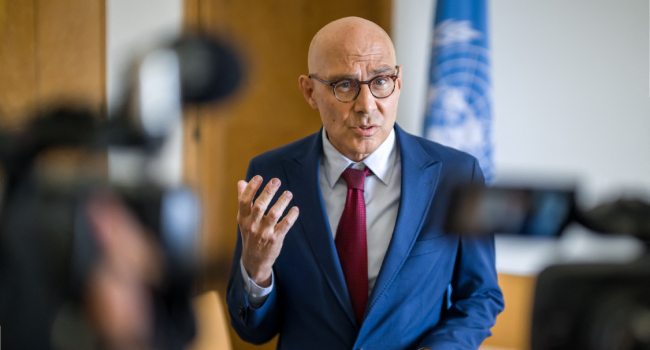
The United Nations’ human rights chief on Thursday urged Guinea’s transitional authorities to lift restrictions on opposition parties and media outlets ahead of elections scheduled for December.
Since overthrowing civilian president Alpha Condé in 2021, junta leader General Mamady Doumbouya has ruled the West African nation with an iron fist.

Several political parties and media organisations have been suspended, demonstrations have been banned since 2022, and numerous opposition leaders have been arrested, jailed, or forced into exile.
“The military authorities in Guinea must first and foremost lift the unacceptable bans on political parties and media outlets,” UN High Commissioner for Human Rights Volker Türk said in a statement.
“It is critical for the transitional authorities to ensure that the process of restoring constitutional rule complies with international human rights norms and standards, including public participation, inclusiveness, and transparency.”
Türk’s remarks followed Prime Minister Amadou Oury Bah’s renewed pledge on Wednesday that the military government would hold legislative and presidential elections this year.
In a referendum on Sunday, Guineans approved a new constitution that sets the stage for the elections but also allows Doumbouya to run for president.
Türk condemned what he described as a wider assault on fundamental rights since the 2021 coup, warning that arbitrary arrests and enforced disappearances appear to be rising. His office said it was “aware of at least 10 individuals whose whereabouts remain unknown following their arrests by security forces”.
Those missing include author and activist Oumar Sylla — also known as Fonike Mengue — and journalist Habib Marouane Camara, both of whom disappeared last year.
Türk called for the release of all those held arbitrarily or subjected to enforced disappearances and demanded “effective, independent and impartial investigations” into these cases.
He also urged authorities to revoke the pardon granted to former president Moussa Dadis Camara, sentenced to 20 years in prison for crimes against humanity over his involvement in a 2009 massacre.
“International law prohibits pardons for such serious crimes,” Türk added.