

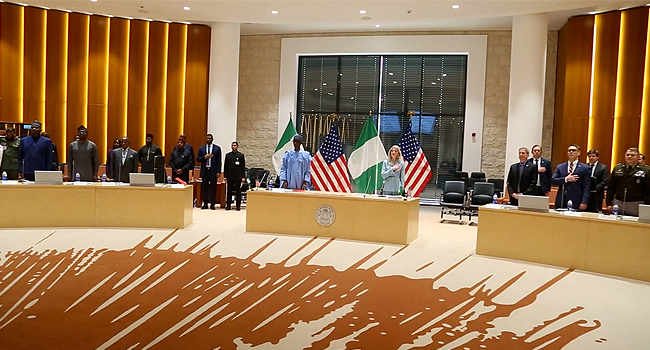
The United States has called on the Nigerian government to strengthen measures aimed at safeguarding Christian communities across the country.
The appeal was made on Thursday by the US Under Secretary for Political Affairs, Allison Hooker, who noted that although some gains have been recorded in recent months, fresh attacks show that more must be done to ensure the safety of Christians.

The call was made during a high-level meeting held in Abuja.
“Today, we are here to discuss how we can work together to deter violence against Christian communities, prioritising counterterrorism and insecurity; investigating attacks and holding perpetrators accountable; and reducing the number of killings, forced displacements, and abductions of Christians, particularly in the North-Central states,” Hooker said at the US–Nigeria Working Group meeting in Abuja.
She acknowledged recent successes, including the release of abducted Christians, attributing them to collaboration between both countries.
“With respect to the protection of Christians, the Nigerian government recently secured the release of 38 Christians abducted from a church in Kwara State, and another 265 abducted from St. Mary’s Catholic School. This real progress is a direct result of our engagement with the Nigerian government and our partnership.
“We are, however, concerned about recent reports that gunmen kidnapped more than 170 Christians in Kaduna State on January 18. We want to see an end to this type of violence. And we are here to work with the Nigerian government with the goal of protecting Christians and their right to practise their faith freely and safely.
“We call for the government to work with the local authorities to find and secure the release of the innocent victims and to work with NGOs to meet the victims’ families’ needs in the meantime,” she added.
Hooker further said progress in religious freedom and security would strengthen broader US–Nigeria relations, including trade, economic cooperation, healthcare responses, and counterterrorism efforts, while also aiding the return of internally displaced persons to their communities.
The meeting in Abuja was attended by senior officials from both the United States and Nigeria.
According to her, improved religious freedom and security would help both countries deepen mutual benefits, “solidifying trade and economic deals, degrading terrorist groups that threaten our interests, and strengthening health responses, among many other areas”.
“We also hope to identify ways to return internally displaced persons to the communities from which they were expelled in the North-Central states, interdict weapons and funding going to terrorist groups, expand investigations, and ensure the prosecution of individuals and groups committing atrocities,” Hooker stated.
‘Protection Of All Citizens Non-Negotiable’
In response, the National Security Adviser (NSA), Nuhu Ribadu, said the administration of President Bola Ahmed Tinubu has taken firm steps to tackle insecurity through intensified joint operations and sustained deployment of security personnel to flashpoint areas, particularly communities facing repeated attacks on civilians and religious groups.
“These directives have been matched with concrete action. Nigeria is expanding early-warning and rapid-response mechanisms, developing a national database to serve as a single, authoritative source of accurate and verifiable data on deaths and casualties arising from violence.
“This effort will strengthen evidence-based decision-making, accountability, and the effectiveness of security responses,” he said.
Ribadu added that investigations and prosecutions linked to attacks on religious communities had been stepped up to ensure accountability.
“Nigeria is a deeply plural society, and the protection of all citizens—Christians, Muslims, and those of other beliefs—is non-negotiable. Violence framed along religious lines is treated as an attack on the Nigerian state itself.
“Our response, therefore, integrates security operations, the rule of law, humanitarian safeguards, and strategic communication, ensuring that operational successes translate into public confidence and strengthened social cohesion,” he said.
US-Nigeria Partnership ‘Working’
While affirming that cooperation between Nigeria and the US remains effective, the NSA stressed that progress should be assessed based on overall direction, policy decisions at the highest levels, and the capacity being built to prevent and punish violence.
“Nigeria believes this is the most responsible and credible basis for partnership and evaluation.
“We also recognise that our partnership with the United States extends well beyond security cooperation. It encompasses democratic resilience, respect for the rule of law, regional stability in West Africa and a shared determination to prevent extremist and malign actors from exploiting governance gaps or social fractures,” he added.
The meeting followed the abduction of more than 100 worshippers in Kurmin Wali community, Kajuru Local Government Area of Kaduna State.
Over 100 worshippers were kidnapped by bandits.
After initially denying the incident, the police later confirmed the attack and abductions, sparking outrage among stakeholders, including the Christian Association of Nigeria (CAN).
“The manner [in which] the police commissioner and other security agencies came out to outright say that this thing did not happen to me, it’s a total disappointment, a total failure, and it’s just increased the lack of trust that exists between the people and those who are securing them,” the chairman of CAN in the northern region, Joseph Hayab, said on Channels Television’s Sunrise Daily.
The development has further raised concerns over religious violence in the country, particularly after Kaduna State authorities and the police reversed their initial denial of the incident.
Nigeria-US Security Group
In November 2025, President Bola Tinubu approved the formation of the Nigerian side of the US–Nigeria Joint Working Group as part of efforts to deepen collaboration on security challenges.
The group’s composition followed agreements reached during a recent visit to Washington, DC, by a high-level Nigerian delegation led by the NSA.
Members include the NSA; Minister of Foreign Affairs, Yusuf Tuggar; Minister of Defence, Mohammed Badaru; Minister of Interior, Olubunmi Tunji-Ojo; Minister of Humanitarian Affairs, Bernard Doro; Chief of Defence Staff, Gen. Olufemi Oluyede; Director-General of the National Intelligence Agency, Mohammed Mohammed; and Inspector General of Police, Kayode Egbetokun.