

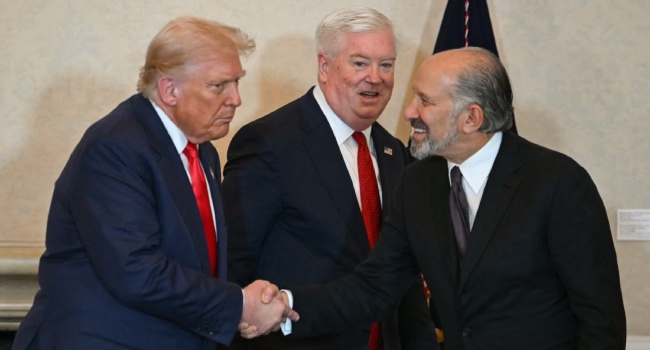
The United States and Japan on Tuesday signed an agreement to “secure” supplies of critical minerals and rare earths, the White House announced, as President Donald Trump continued his visit to Tokyo.
The deal forms part of Washington’s broader effort to strengthen access to critical minerals amid China’s tightening control over the rare earths industry.

According to a joint statement, the agreement aims “to help both countries achieve resilience and security in the supply chains for critical minerals and rare earths.”
Both nations also agreed to expand cooperation in shipbuilding and said several Japanese investment projects in energy, artificial intelligence, and other sectors are under consideration, though specific details remain limited.
The United States and Japan will “jointly identify projects of interest to address supply chain gaps” involving critical minerals and their derivative products, such as permanent magnets, batteries, catalysts, and optical materials.
The statement added that both countries “intend to mobilise government and private sector support” for these initiatives.
Beijing’s recent move to impose sweeping restrictions on its rare earths industry has triggered a strong response from Washington, with President Trump threatening to introduce 100 per cent tariffs on Chinese imports in retaliation.
Earlier in his Asian tour, Trump and Malaysian Prime Minister Anwar Ibrahim signed a trade agreement to boost US access to critical minerals.
US Secretary of Commerce Howard Lutnick, who accompanied the president, also signed a memorandum of cooperation on shipbuilding with Japan’s transport minister, Yasushi Kaneko.
Under the agreement signed on Tuesday, the United States and Japan will establish a joint working group to enhance shipbuilding capacity, share best practices, and promote strategic investments to modernise shipyards.
China currently dominates the global shipbuilding market, while the US industry has suffered a steady decline. Trump, however, pledged to revive the sector.
“We used to be number one at making ships, and then we lost our way,” he said. “We’re going to be working with Japan on shipbuilding again — we’re going to make a lot of ships.”
In exchange for a trade agreement reached in July that reduced tariffs on Japan, the United States is seeking $550 billion in Japanese investments, though negotiations are ongoing.
Projects reportedly under discussion include major energy ventures, with up to $100 billion earmarked for building nuclear reactors by American company Westinghouse, and another $100 billion for small modular reactors (SMRs) by US firm GE Vernova.
Tokyo’s document also highlighted projects focused on “strengthening AI infrastructure,” involving Japanese firms such as Toshiba, Hitachi, and Mitsubishi Electric, alongside multiple plans to develop factories for processing critical minerals.