

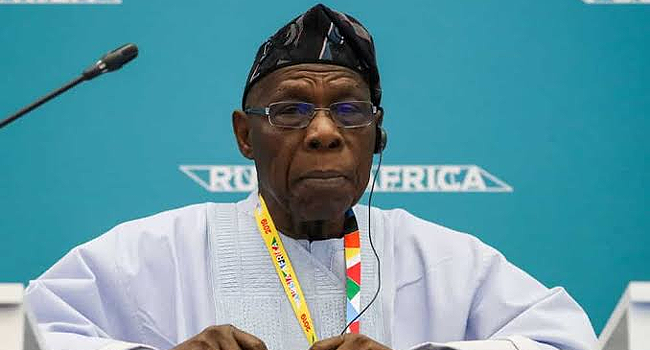
Former Presidents Goodluck Jonathan and Olusegun Obasanjo have called for a fundamental review of Nigeria’s and Africa’s democratic systems, arguing that the Western liberal model adopted by African countries has failed to adequately address their political, cultural and developmental realities.
The former presidents spoke on Tuesday in Bauchi at the 2026 Goodluck Jonathan Foundation Democracy Dialogue, themed: “Beyond Elections: Can Political Parties and the Judiciary Save African Democracy?”

Jonathan, who chairs the foundation, said African countries should reconsider the excessive concentration of powers in the presidency and explore models that promote power-sharing, accountability and political stability.
He questioned whether the president should continue to wield enormous powers over virtually all major decisions in the country.
“If you look at the structure of government alone, do we really continue with one man having maximum power to cut the yam anyhow he likes? Or do we dilute the powers and adopt a model similar to the Swiss model?” he asked.
Jonathan said collective decision-making had contributed to Switzerland’s political stability and economic development, arguing that no individual should have the power to unilaterally determine major policies and projects.
He suggested that African countries could revisit aspects of the parliamentary system practised during the independence era, where executive powers were shared between the president and prime minister.
“Probably the way to go is back to the pre-independence and early independence period of having a parliamentary system where at least the powers are shared,” he said.
According to him, dividing executive responsibilities would create checks and balances and prevent the concentration of presidential powers in one individual.
He, however, said more consultations were needed to determine the democratic model best suited to Africa’s peculiar circumstances.
Jonathan said the dialogue was part of efforts to deepen conversations on the future of democracy on the continent, noting that the foundation would use contributions from participants to shape future editions of the event.
On his part, Obasanjo said Africa needed to develop a democratic system that reflected its own culture, values and diversity rather than continuing to copy the Western liberal model inherited from colonial rulers.
He said the central question should be whether the system had delivered good governance, improved the welfare of citizens and guaranteed equity, inclusion, security and a sense of belonging.
“We were given Western liberal democracy by our colonial masters. Since our European colonial masters had nothing else to give us, we swallowed it, hook, stock and barrel. Has it delivered, is it delivering or will it deliver?” Obasanjo asked.
The former president said democracy should be understood as a system in which power belongs to the people, but argued that Nigeria’s representative democracy had increasingly failed to reflect the interests of citizens.
He criticised the growing influence of political parties over elected representatives, saying politicians often abandoned the interests of their constituencies after securing electoral victory.
Obasanjo also faulted the practice of “winner takes all”, warning that it was particularly dangerous in a country as diverse as Nigeria.
“You cannot have a democracy that completely rides roughshod over diversity,” he said, stressing that Nigeria’s ethnic, religious and cultural diversity must be recognised and accommodated in its political system.
He argued that Western democracy developed within a different historical context and therefore could not simply be transplanted into Africa without adaptation.
“Democracy we practise has no African context. And if you try to use what is not meant for you to serve your purpose, it’s like a dress for which you are not measured,” he said.
Obasanjo also criticised the role of money in Nigerian politics, gender imbalance and the quality of political leadership, noting that Nigeria had yet to elect a female governor more than two decades into the Fourth Republic.
He said democracy was not a destination but a continuous journey that required constant review and improvement.
The former president therefore advocated the development of an African democratic model rooted in peace, culture and values.
