

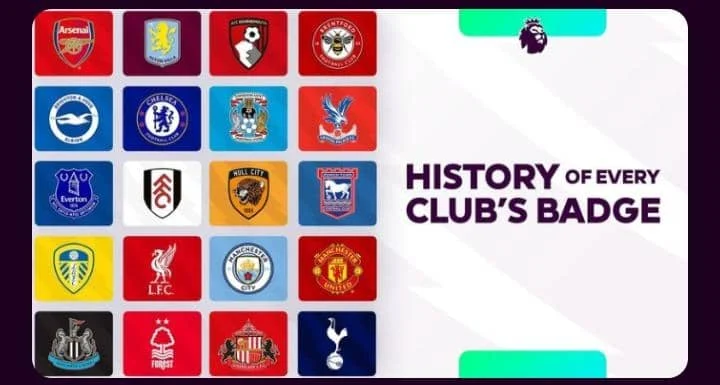
A football club badge is more than a symbol of identity. For many Premier League clubs, the colours, animals, landmarks and other images on their crests reflect their origins, local history, nicknames, major achievements and links to their communities.
Why does Arsenal have a cannon? Who is the player featured on Bournemouth’s badge? What does Coventry City’s elephant represent? And why does Liverpool have a Liver Bird?

Here is the story behind the badges of all 20 Premier League clubs in the 2026/27 season, based on information published by the Premier League.
1. Arsenal — Why is there a cannon on Arsenal’s badge?
Arsenal’s current badge, introduced in 2002, features an eastward-facing cannon.
The cannon reflects the club’s origins at the Royal Arsenal in Woolwich, where munitions workers founded Arsenal in 1886. It also explains the club’s nickname, the Gunners.
The crest uses two shades of red, reflecting Arsenal’s traditional colours and those worn in the club’s early years.
Before the badge was simplified in 2002, it featured the Latin motto Victoria Concordia Crescit, meaning “Victory through harmony”, along with the coat of arms of the Borough of Islington.
2. Aston Villa — What does the lion on the badge mean?
Aston Villa’s current badge was unveiled in 2024 and features a lion inspired by the Scottish coat of arms.
The symbol is linked to former Villa chairman William McGregor, who was Scottish.
A white star above the yellow lion commemorates Villa’s 1982 European Cup victory over Bayern Munich, while the club’s founding year, 1874, also appears on the crest.
The badge retains Villa’s traditional claret and sky blue colours and returned to a shield design after the club used a circular crest during the 2023/24 season.
3. Bournemouth — Who is the player on Bournemouth’s badge?
The silhouette on AFC Bournemouth’s badge is former striker Dickie Dowsett.
Dowsett played for the Cherries during the 1950s and 1960s before becoming the club’s commercial manager. He helped redesign the badge in 1972, when his image was incorporated into the crest.
His profile has remained on the badge apart from a brief period between 1981 and 1983, when a bunch of cherries replaced it.
The red and black stripes represent Bournemouth’s traditional home colours, which were originally inspired by Italian club AC Milan.
4. Brentford — Why is there a bee on Brentford’s badge?
Brentford’s badge features a buff-tailed bumblebee, reflecting the club’s nickname, the Bees.
The nickname dates back to the 1890s. Students from Borough Road College reportedly attended a Brentford match and chanted “Buck up Bs”. Journalists apparently misheard the chant as “Buck up Bees”, helping establish the nickname.
The modern circular badge also features the club’s name and founding year, 1889.
5. Brighton — Why does Brighton have a seagull on its badge?
Brighton & Hove Albion’s circular crest features a white seagull against the club’s traditional blue and white colours.
The club was previously known as the Dolphins, but supporters adopted the Seagulls nickname in the mid-1970s.
The change reportedly followed chants from Crystal Palace supporters referring to themselves as Eagles. A seagull has appeared on Brighton’s badge since 1977, apart from the club’s centenary season in 2001/02.
6. Chelsea — What does the lion on Chelsea’s badge represent?
Chelsea’s badge is centred on a blue lion looking backwards while holding a staff.
The lion was adopted after Ted Drake became manager in 1953 and was based on an element of the coat of arms of the former Metropolitan Borough of Chelsea.
The staff represents the Abbot of Westminster, historic landholders in the area.
Two red Tudor roses, representing England, and two footballs also feature on the badge.
7. Coventry City — Why does Coventry’s badge have an elephant?
Coventry City’s badge includes an elephant carrying a castle, alongside a phoenix and an eagle.
The symbols are drawn from Coventry’s coat of arms.
The castle represents Coventry Castle, while the elephant symbolises strength. The red cross on the elephant is the St George’s Cross and reflects the historic belief that St George was born in the area.
The phoenix rising from flames represents Coventry’s revival after the devastation of the Second World War.
The eagle represents Leofric, Earl of Mercia, who founded monasteries in Coventry.
A football in the centre of the crest uses Coventry’s traditional sky blue and white colours.
8. Crystal Palace — Why does Crystal Palace have an eagle?
Crystal Palace’s badge features an eagle perched on the roof of the historic Crystal Palace exhibition building.
The structure was built for the Great Exhibition in 1851.
The eagle has featured on Palace’s badge since 1973, when manager Malcolm Allison changed the club’s nickname from the Glaziers to the Eagles. The change was inspired by Portuguese club Benfica.
The crest also uses Palace’s traditional red and blue colours.
In 2022, the date on the badge was changed from 1905 to 1861 to recognise the formation of the original football team by cricket players.
9. Everton — What does the tower on Everton’s badge mean?
The centrepiece of Everton’s badge is Prince Rupert’s Tower, a historic lock-up on Everton Brow.
The tower has been part of Everton’s visual identity for decades.
Two laurel wreaths flank the tower and represent victory, reflecting the traditional use of laurel wreaths to honour champions.
The badge also carries the club’s founding year, 1878, and the Latin motto Nil Satis Nisi Optimum, meaning “Nothing but the best is good enough”.
The tower, wreaths and motto were all included in the design created by club secretary Theo Kelly in 1938.
10. Fulham — What do the letters on Fulham’s badge mean?
Fulham’s minimalist crest was introduced in 2001, the year the club began its first Premier League campaign.
The badge features a black-and-white shield representing Fulham’s traditional colours.
The initials “FFC”, standing for Fulham Football Club, run vertically through the centre in a red monogram.
The previous badge was heavily influenced by the coat of arms of the London Borough of Hammersmith and Fulham.
11. Hull City — Why does Hull City have a tiger?
Hull City’s badge features a tiger’s head, reflecting the club’s nickname, the Tigers.
The nickname is associated with Hull’s traditional amber and black home colours.
The tiger sits inside an amber shield above the club’s founding year, 1904.
The words “Hull City” were added to the top of the current badge, which was introduced in 2019.
12. Ipswich Town — What is the horse on Ipswich’s badge?
The animal on Ipswich Town’s crest is a Suffolk Punch, a famous local breed of heavy workhorse.
The badge also contains turrets representing Ipswich’s Wolsey Gate, while the wavy lines at the bottom reflect the town’s waterways and maritime heritage.
The current crest has been used since 1995 and is based on a design created by John Gammage, who won a supporters’ club competition in 1972.
13. Leeds United — What does the rose on Leeds’ badge mean?
Leeds United’s badge features the White Rose of York, a historic symbol of Yorkshire and a symbol associated with the royal House of York.
The shield also carries the letters “LUFC”, representing Leeds United Football Club, across blue and yellow stripes.
The club’s blue and yellow colours were originally inspired by the coat of arms of the city of Leeds.
14. Liverpool — Why does Liverpool have a Liver Bird?
Liverpool’s simplified kit badge features the Liver Bird, a mythical creature traditionally depicted as a cormorant.
The bird has been associated with Liverpool for centuries and sits above the initials “L.F.C.”
The branch of laver seaweed in its beak has both local and linguistic significance, reflecting Liverpool’s coastal setting while also providing a wordplay connection with the city’s name.
Liverpool’s full heraldic crest contains additional references to the club’s history, including the Shankly Gates and the Hillsborough Memorial, which commemorates the 97 supporters who died in the 1989 stadium disaster.
15. Manchester City — What do the ship and three stripes on Man City’s badge mean?
Manchester City’s circular badge features a golden three-masted ship inside a shield.
The ship represents the Manchester Ship Canal and the city’s trading history.
Three diagonal stripes represent the three rivers associated with Manchester — the Irk, the Irwell and the Medlock.
The lower part of the shield contains the red rose of Lancashire, reflecting the club’s regional identity.
The outer circle carries the club’s name and founding year, 1894.
The current badge was introduced in 2016, replacing the eagle design that had been used since 1997.
16. Manchester United — Why does Man United have a red devil?
Manchester United’s badge features a red devil holding a pitchfork.
The symbol became associated with the club after manager Sir Matt Busby adopted the “Red Devils” nickname in the 1960s. The nickname was linked to Salford, whose rugby league club had previously used it.
The badge also contains a three-masted ship drawn from Manchester’s coat of arms, reflecting the city’s history as a trading centre.
Two footballs and red banners complete the crest.
The club simplified the badge in 1998 by removing the words “Football Club”.
17. Newcastle United — What do the symbols on Newcastle’s badge mean?
Newcastle United’s badge draws heavily from the coat of arms of the city.
The shield contains the club’s famous black and white stripes, while a castle keep represents the Norman fortress from which Newcastle takes its name.
A lion carrying St George’s Cross sits above the castle, while two mythical seahorses flank the shield.
The seahorses represent Newcastle’s historic links with the River Tyne and its maritime heritage.
The club’s name appears on a scroll below the crest.
The current badge was introduced in 1988. Newcastle are also working on an updated badge, with supporters voting on proposed designs, according to the Premier League.
18. Nottingham Forest — Why does Nottingham Forest have a tree?
Nottingham Forest’s badge features a tree representing Sherwood Forest, the woodland strongly associated with Nottingham and the club’s name.
The wavy lines underneath the tree represent the River Trent, which runs through Nottingham and alongside the City Ground.
The badge was designed in 1974 following a public competition won by graphic design lecturer David Lewis.
Two stars were later added to commemorate Forest’s European Cup victories in 1979 and 1980 under manager Brian Clough.
19. Sunderland — What do the symbols on Sunderland’s badge mean?
Sunderland’s badge contains several references to the club’s local surroundings and history.
The quartered shield features Wearmouth Bridge and Penshaw Monument, two prominent local landmarks.
The top and bottom sections use Sunderland’s traditional red and white stripes.
Two black lions support the shield, reflecting both the city’s coat of arms and Sunderland’s Black Cats nickname.
A colliery wheel sits above the shield as a tribute to County Durham’s coal-mining heritage and the colliery that once stood on the site of the club’s stadium.
The badge also carries the Latin motto Consectatio Excellentiae, meaning “in pursuit of excellence”.
20. Tottenham Hotspur — Why does Tottenham have a cockerel?
Tottenham Hotspur’s badge features a cockerel standing on an old-fashioned football.
The cockerel has been associated with the club for more than a century and is linked to Sir Henry Percy, the medieval knight better known as Harry Hotspur.
Percy was reputed to have attached spurs to his fighting cockerels, a connection that helped inspire Tottenham’s use of the symbol.
Tottenham simplified its badge in 2006, removing additional elements and leaving the cockerel and football as the main design.
The crest was tweaked again in 2013 and simplified further in 2024, when the curved “Tottenham Hotspur” wording beneath the cockerel was removed.
From cannons to cockerels
Premier League badges represent far more than football clubs.
Their designs preserve references to local landmarks, historical figures, nicknames, colours, industries, cities and defining moments in club history.
From Arsenal’s cannon and Coventry City’s elephant to Liverpool’s Liver Bird and Tottenham’s cockerel, each crest offers a visual link between a club’s present and its past.
