

The debate over the greatest football player of all time remains one of the sport’s most enduring arguments.
Across different generations, football has produced players capable of transforming matches, winning major trophies and redefining what is possible on the pitch.

From Pelé and Diego Maradona to Lionel Messi and Cristiano Ronaldo, there has never been a universally accepted answer to the question.
However, factors including individual ability, career longevity, goals and assists, major trophies, international success, individual awards, big-game performances and influence on football can help shape such a ranking.
Based on these criteria, Lionel Messi ranks first, followed by Cristiano Ronaldo, Pelé and Diego Maradona.
There is no official FIFA or UEFA ranking for the greatest footballers in history, making this an editorial ranking.
The players were assessed using several key criteria:
- Individual ability and technical quality
- Career statistics
- Major trophies won
- International achievements
- Individual awards
- Performances in major competitions
- Longevity and consistency
- Influence on their clubs, countries and the wider game
- Peak performance and legacy
Football has changed considerably across generations, meaning raw statistics cannot be used as the sole basis for comparison.
A player from the 1950s, for instance, cannot be assessed entirely using the same statistical standards applied to a modern footballer.
1. Lionel Messi
Argentina | Forward | 2004–present
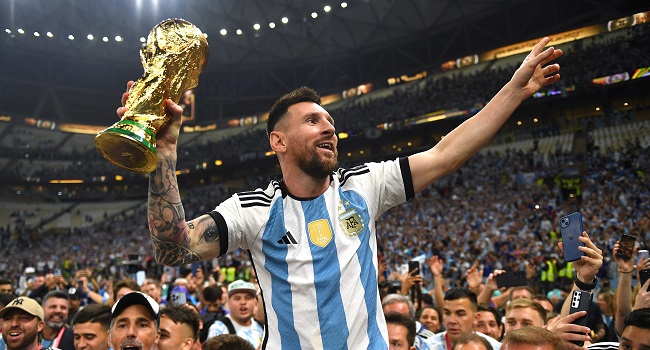
Lionel Messi ranks first in this list of the greatest football players of all time.
His combination of goalscoring, playmaking, dribbling, chance creation, consistency and longevity gives him an exceptionally strong case.
Messi has won the biggest trophies available to him, including the FIFA World Cup, Copa América and UEFA Champions League. He has also won eight Ballon d’Or awards, the most in the history of the prize.
His World Cup journey has been particularly important to his legacy.
After years of criticism surrounding his international record, Messi led Argentina to the 2022 World Cup in Qatar, scoring seven goals and winning the Golden Ball.
He later added another impressive World Cup campaign in 2026, taking his World Cup tally to 21 goals in 34 appearances, according to FIFA.
Messi’s career statistics are equally remarkable, with current records putting him beyond 900 senior career goals across Barcelona, Paris Saint-Germain, Inter Miami and Argentina.
| Category | Lionel Messi |
|---|---|
| Ballon d’Or | 8 |
| FIFA World Cup | 1 |
| Copa América | 2 |
| UEFA Champions League | 4 |
| La Liga titles | 10 |
| European Golden Shoes | 6 |
| Argentina goals | 125 |
| World Cup goals | 21 |
| World Cup appearances | 34 |
| Senior career goals | 900+ |
Messi combines the qualities of a goalscorer and midfielder better than almost any player in football history.
He can control matches without scoring, create chances from seemingly impossible situations, beat several defenders, score free-kicks and produce decisive moments in major finals.
His longevity is another important part of his case. Today, he has hanged his boots for the national team.
Verdict: The most complete attacking footballer of his generation and, in this ranking, the greatest player football has produced.
2. Cristiano Ronaldo
Portugal | Forward | 2002–present
If Messi represents the ultimate combination of playmaking and goalscoring, Cristiano Ronaldo represents one of the greatest examples of goalscoring and athletic evolution in football history.
Ronaldo has excelled in England, Spain, Italy and Saudi Arabia while becoming Portugal’s all-time leading international goalscorer.
As of October 2026, current career figures put Ronaldo on 979 senior goals, leaving him 21 goals short of the 1,000-goal milestone.
His record at Real Madrid further demonstrates his extraordinary level. The Portuguese forward scored 451 goals in 438 competitive appearances for the Spanish giants.
He also holds the record for the most Champions League goals, with 140 in current career records.
| Category | Cristiano Ronaldo |
|---|---|
| Ballon d’Or | 5 |
| UEFA Champions League | 5 |
| FIFA World Cup | 0 |
| European Championship | 1 |
| UEFA Nations League | 2 |
| Portugal goals | 146 |
| Champions League goals | 140 |
| Senior career goals | 979 |
| Real Madrid goals | 451 |
Ronaldo’s international career is also remarkable. He has scored more goals for a men’s national team than any other player and has continued performing at an elite level into his 40s.
FIFA has documented his development from a winger at Manchester United into an elite goalscorer capable of finding the net with both feet, from distance and in the air.
Verdict: The greatest goalscorer of the modern era and one of football’s most complete forwards.
3. Pelé
Brazil | Forward | 1956–1977
Before Messi and Ronaldo dominated the modern era, Pelé was the benchmark for football greatness.
Known as the King of Football, Pelé remains the only player to have won three FIFA World Cups.
He lifted the trophy with Brazil in 1958, 1962 and 1970, a record that remains unmatched.
Pelé was only 17 when he became a World Cup winner in 1958, making him the youngest player to win the tournament.
His official career statistics are sometimes disputed because different organisations count friendlies and exhibition matches differently. Reuters’ widely used official-match tally credits him with 757 goals in 812 official matches, while Brazilian sources have historically used significantly higher figures that include non-official games.
| Category | Pelé |
|---|---|
| FIFA World Cups | 3 |
| Brazil goals | 77 |
| World Cup goals | 12 |
| World Cup titles | 1958, 1962, 1970 |
| Copa Libertadores | 2 |
| Brazilian league titles | 6 |
| Official career goals | 757* |
| Santos competitive goals | 643 |
Pelé also won two Copa Libertadores titles with Santos and six Brazilian league championships.
Verdict: The most successful World Cup player ever and the defining football superstar of his generation.
4. Diego Maradona
Argentina | Attacking midfielder | 1976–1997
Diego Maradona’s case is built around extraordinary peak brilliance and influence.
Few players have carried a team as heavily as Maradona did during Argentina’s 1986 World Cup triumph and Napoli’s rise in Italian football.
At the 1986 World Cup, Maradona scored five goals and provided five assists as Argentina won the tournament.
His quarter-final performance against England produced two of the most famous goals in football history: the “Hand of God” and the “Goal of the Century.”
FIFA records Maradona among the players with the most World Cup appearances, with 21 matches across four tournaments.
| Category | Diego Maradona |
|---|---|
| Argentina caps | 91 |
| Argentina goals | 34 |
| World Cup appearances | 21 |
| World Cup goals | 8 |
| World Cup titles | 1 |
| Serie A titles | 2 |
| UEFA Cup | 1 |
| Club goals | 300+ |
Maradona’s most significant club achievement came at Napoli, where he won two Serie A titles and the UEFA Cup, helping transform the Italian club into a major force.
Verdict: Perhaps the greatest example of an individual player carrying a team through personality, creativity and ability.
5. Johan Cruyff
Netherlands | Forward/attacking midfielder | 1964–1984
Johan Cruyff changed football both through his performances as a player and his ideas about the game.
The Dutchman was the central figure in the famous Total Football philosophy associated with Ajax and the Netherlands.
Cruyff won three Ballon d’Or awards and played a key role in Ajax’s three consecutive European Cup triumphs between 1971 and 1973.
UEFA records Cruyff with 704 club appearances and 392 goals, while he scored 33 goals in 48 appearances for the Netherlands.
| Category | Johan Cruyff |
|---|---|
| Ballon d’Or | 3 |
| European Cups | 3 |
| Netherlands caps | 48 |
| Netherlands goals | 33 |
| Club appearances | 704 |
| Club goals | 392 |
| World Cup finals | 1 |
| World Cup result | Runner-up, 1974 |
Cruyff’s importance went beyond his statistics.
His understanding of space, movement, pressing and positional football influenced generations of players and coaches, including during his later work as Barcelona manager.
He helped transform Barcelona as a player before returning to the club as a coach, where his ideas influenced the foundations of the modern Barça philosophy.
Verdict: One of football’s greatest players and one of its most important tactical innovators.
6. Franz Beckenbauer
West Germany | Defender/libero | 1964–1983
Placing a defender among the greatest players ever is difficult, but Franz Beckenbauer’s achievements make his inclusion difficult to dispute.
Known as the Kaiser, Beckenbauer revolutionised the libero role by combining defensive intelligence with passing, ball carrying and leadership.
He won the 1974 World Cup as captain of West Germany and later became a world champion again as a coach in 1990.
| Category | Franz Beckenbauer |
|---|---|
| Ballon d’Or | 2 |
| FIFA World Cup | 1 |
| European Championship | 1 |
| European Cups | 3 |
| Germany caps | 103 |
| Germany goals | 14 |
| Bundesliga appearances | 396 |
| Bundesliga goals | 44 |
Beckenbauer remains one of the few people to win the World Cup both as a player and as a coach.
Verdict: The greatest defender/libero on this list and arguably the most influential defensive player in football history.
7. Ronaldo Nazário
Brazil | Striker | 1993–2011
Before injuries disrupted his prime, Ronaldo Nazário was arguably the most feared striker in world football.
His combination of acceleration, strength, dribbling, finishing and movement made him extremely difficult to defend against.
Ronaldo scored 15 goals in 19 World Cup matches, a record that stood as the tournament’s best mark among Brazilian players until later generations emerged.
He won two World Cups with Brazil, although he did not feature in Brazil’s matches in 1994. His greatest World Cup moment came in 2002, when he scored both goals in Brazil’s 2-0 final victory over Germany.
| Category | Ronaldo Nazário |
|---|---|
| FIFA World Cups | 2 |
| Brazil caps | 98 |
| Brazil goals | 62 |
| World Cup goals | 15 |
| Ballon d’Or | 2 |
| FIFA World Player awards | 3 |
| Career appearances | 615 |
| Career goals | 414 |
Ronaldo’s club career included spells at PSV, Barcelona, Inter Milan, Real Madrid, AC Milan and Corinthians, with 414 goals recorded across his club and international career in one major statistical compilation.
Verdict: Injuries prevented an even greater statistical legacy, but at his peak, few forwards in history were more devastating.
8. Alfredo Di Stéfano
Argentina/Spain | Forward | 1945–1966
Alfredo Di Stéfano was the driving force behind Real Madrid’s first European dynasty.
He was more than a goalscorer, regularly dropping deep, creating attacks, defending, controlling the tempo and finishing moves.
Real Madrid’s official records credit Di Stéfano with 396 official appearances and 308 goals for the club.
More importantly, he led Madrid to five consecutive European Cups, scoring in every one of those finals.
He also won eight Spanish league titles, one Spanish Cup and an Intercontinental Cup with the club.
| Category | Alfredo Di Stéfano |
|---|---|
| Real Madrid appearances | 396 |
| Real Madrid goals | 308 |
| European Cups | 5 |
| La Liga titles | 8 |
| Intercontinental Cups | 1 |
| Ballon d’Or | 2 |
| Super Ballon d’Or | 1 |
| Pichichi trophies | 5 |
Di Stéfano remains the only recipient of the Super Ballon d’Or, awarded by France Football in 1989.
Verdict: The complete footballer who helped establish Real Madrid as the dominant force of early European football.
9. Zinedine Zidane
France | Midfielder | 1989–2006
Few midfielders have combined elegance, technique, control and big-game influence like Zinedine Zidane.
The Frenchman was central to France’s golden generation, scoring twice in the 1998 World Cup final as France defeated Brazil 3-0.
He then helped France win Euro 2000.
At club level, Zidane enjoyed successful spells with Juventus and Real Madrid and scored one of the most iconic goals in Champions League final history with his left-foot volley against Bayer Leverkusen in 2002.
| Category | Zinedine Zidane |
|---|---|
| France caps | 108 |
| France goals | 31 |
| FIFA World Cup | 1 |
| European Championship | 1 |
| Champions League | 1 |
| Ballon d’Or | 1 |
| FIFA World Player awards | 3 |
| Real Madrid appearances | 227 |
| Real Madrid goals | 49 |
The French Football Federation confirms Zidane’s 108 caps and 31 international goals, alongside his World Cup, European Championship and three World Cup campaigns.
Real Madrid also credits him with 227 official appearances and 49 goals for the club.
Verdict: One of the greatest midfielders ever and a player whose reputation became even stronger on football’s biggest stages.
10. Ronaldinho
Brazil | Attacking midfielder | 1998–2018
Ronaldinho completes the top 10 and remains one of the most entertaining players football has ever produced.
The Brazilian combined flair, creativity, improvisation and exceptional technical ability.
At Barcelona, Ronaldinho helped transform the club’s fortunes, winning two La Liga titles and the 2006 Champions League.
| Category | Ronaldinho |
|---|---|
| Brazil caps | 97 |
| Brazil goals | 33 |
| FIFA World Cup | 1 |
| Copa América | 1 |
| Confederations Cup | 1 |
| Champions League | 1 |
| Ballon d’Or | 1 |
| FIFA World Player awards | 2 |
| Barcelona appearances | 207 |
| Barcelona goals | 98 |
Barcelona’s official records credit him with 98 goals in 207 matches for the club, while he also won the Ballon d’Or in 2005.
Ronaldinho was also part of Brazil’s 2002 World Cup-winning squad and remains one of the most influential entertainers of the modern game.
Verdict: His peak was shorter than that of some players above him, but few footballers have made the sport look as joyful and effortless.
Top 10 greatest football players of all time
| Rank | Player | Country | Position | Defining achievement |
|---|---|---|---|---|
| 1 | Lionel Messi | Argentina | Forward | World Cup, 8 Ballon d’Ors, 4 Champions Leagues |
| 2 | Cristiano Ronaldo | Portugal | Forward | 5 Champions Leagues, Euro 2016, 900+ career goals |
| 3 | Pelé | Brazil | Forward | 3 World Cups |
| 4 | Diego Maradona | Argentina | Attacking midfielder | 1986 World Cup, 2 Serie A titles |
| 5 | Johan Cruyff | Netherlands | Forward/Midfielder | 3 European Cups, Total Football pioneer |
| 6 | Franz Beckenbauer | Germany | Defender/Libero | World Cup, 3 European Cups |
| 7 | Ronaldo Nazário | Brazil | Striker | 2 World Cups, 15 World Cup goals |
| 8 | Alfredo Di Stéfano | Argentina/Spain | Forward | 5 consecutive European Cups |
| 9 | Zinedine Zidane | France | Midfielder | World Cup, Euro 2000, Champions League |
| 10 | Ronaldinho | Brazil | Attacking midfielder | World Cup, Champions League, Ballon d’Or |