

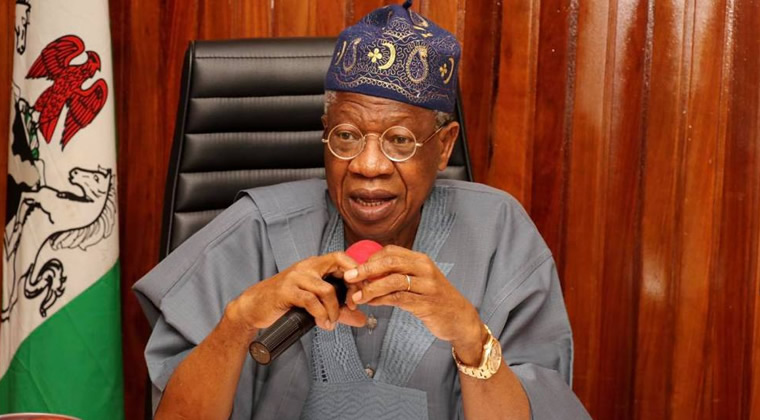
The former minister of information, Lai Mohammed, has maintained that there was no massacre at the Lekki tollgate in Lagos during the #EndSARS demonstrations.
CNN had reported that soldiers fired live rounds at protesters on October 20, 2020.

But the army consistently denied using live ammunition, insisting it only discharged blank rounds to disperse the crowd after a curfew was declared.
At the time, Mohammed wrote to Jonathan Hawkins, VP communications at CNN, arguing that the report “did not just fall short of journalistic standards but reinforces the disinformation that is going around on the issue”.
He said CNN relied “heavily on manipulated social media videos”, warning that the “inciting report” could ignite unrest across the country.
In an interview on Arise Television’s Prime Time on Wednesday, he stated that no one ever claimed there were no fatalities during the wider unrest, pointing out that deaths were recorded in Abuja, Lagos, and Kano.
However, he firmly disputed CNN’s account of the tollgate incident, saying the network was not present at the scene and depended on second-hand material.
“You mentioned the issue of CNN. And honestly, that pushback, I still stand by it,” he said.
“Nobody ever said nobody died during the #EndSARS. People died even in Abuja. They died in Lagos. They died in Kano. But what we were saying is that CNN was not at the tollgate. CNN relied on second-hand thought and information.”
Mohammed added that five years later, no families have reported missing relatives linked to the tollgate, describing the “massacre” narrative as “fake news”.
“If a man has a goat and the goat does not come home one night, he will go out and look for that goat. Now, five years on today, nobody has come to tell us that my son or my ward went to the tollgate and didn’t come back,” he said.
“#EndSARS was unfortunate, it was tragic, but that there was a massacre at the tollgate is fake news.”
He also revealed that during the protests, his family held a meeting urging him to step down. They faced severe online and offline harassment — including threats to their businesses — and questioned why they were being exposed to such risks.
Mohammed said he explained that resignation was not a simple option because he had information and context they did not.
“During the #EndSARS, one of the toughest moments in my life was when my family met. They had a meeting and they asked me to resign. They were bullied online.
“They were bullied offline. Their businesses… they’d had enough. They said, look, wait a minute. We are not benefiting from this thing.
“So why are you exposing us? And I had to sit them down and tell them it’s not as easy as that. There are things I know. There are things that I see that you cannot see.”
On the suspension of Twitter (now X), Mohammed said the decision was among the hardest he had to take during his time in office.
President Muhammadu Buhari halted the platform’s operations in Nigeria in 2021 after one of his posts was taken down.
“One of the most difficult decisions I took was suspending Twitter’s operation in Nigeria. I had to take that decision in the national interest because a time came when Twitter became the platform of choice for all those who wanted to destabilise the country,” he said.
“There are some decisions that you have to take, not because you like them.”
He rejected claims that the suspension was revenge for Twitter removing Buhari’s message directed at pro-Biafra agitators.
“I went to President Buhari and told him we needed to suspend Twitter’s operations. He asked me why and specifically said, ‘Is it because they deleted my tweet?’ I said no, sir, and I gave him instances and examples,” Mohammed said.