

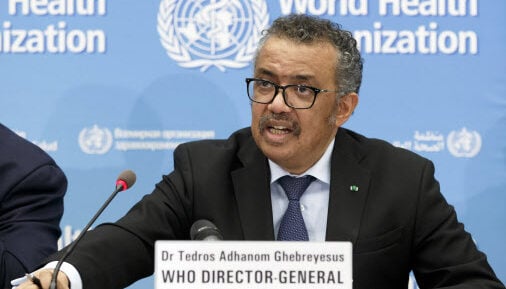
World Health Organization Director-General Tedros Adhanom Ghebreyesus said on Tuesday that efforts to contain hantavirus were still ongoing following the evacuation of passengers from a cruise ship affected by a deadly outbreak.
The situation involving the MV Hondius has raised international concern after three passengers died during the outbreak of the rare virus, which currently has no vaccine or specific treatment.

However, health authorities stressed that the global public health risk remains low and dismissed comparisons with the early stages of the Covid-19 pandemic.
“There is no sign that we are seeing the start of a larger outbreak,” Tedros said during a joint press conference in Madrid alongside Spanish Prime Minister Pedro Sanchez.
“But of course the situation could change, and given the long incubation period of the virus, it’s possible we might see more cases in the coming weeks,” Tedros added.
Authorities evacuated more than 120 passengers and crew members from the MV Hondius from Spain’s Canary Islands on Sunday and Monday, while different countries introduced varying health measures for returning evacuees.
Most countries adopted WHO recommendations, including a 42-day quarantine period and continuous monitoring of high-risk contacts.
In the United States, however, Jay Bhattacharya, acting director of the Centers for Disease Control and Prevention (CDC), said American passengers would not automatically face quarantine measures.
“I hope they (countries) will follow the advice and recommendations we are making,” Tedros said in Madrid.
The MV Hondius also created diplomatic tensions as countries debated who would accept the vessel and handle infected passengers.
Cape Verde refused to receive the ship, which remained anchored off Praia, its capital, while authorities airlifted three people to Europe last week.
Spain later permitted the vessel to anchor off the Canary Islands to allow the evacuation of passengers and crew on Sunday and Monday, despite strong opposition from the regional government of the Atlantic archipelago.
Defending the decision, Sanchez said the “world does not need more selfishness or more fear. What it needs are countries that show solidarity and want to step forward.”