

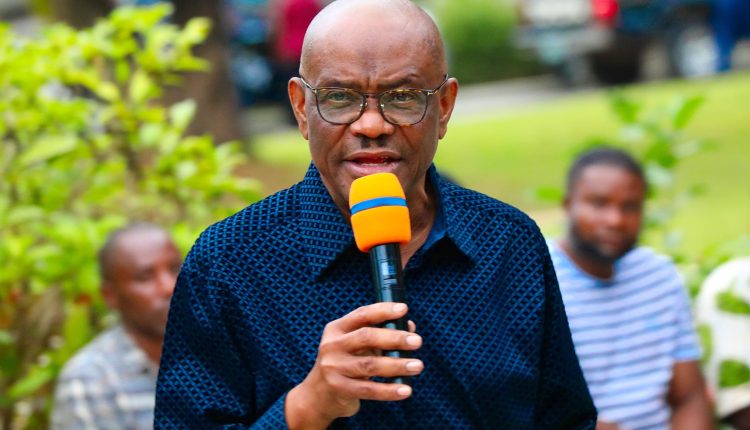
Minister of the Federal Capital Territory (FCT), Nyesom Wike, has attributed Nigeria’s ongoing infrastructure transformation to the leadership, vision and political will of President Bola Tinubu, saying the administration is steadily narrowing the country’s long-standing development deficit.
Wike made the remarks on Saturday while delivering a lecture titled “Leadership and Infrastructure Development in Nigeria: Lessons for Future Leaders” at the 36th Convocation Ceremony of the University of Port Harcourt.

According to the minister, the scale and pace of infrastructure projects being executed across the country demonstrate a clear commitment to national development and economic transformation.
He said President Tinubu has shown the courage to make difficult decisions and mobilise resources towards addressing Nigeria’s infrastructure challenges.
“What the present moment offers is a rare and defining possibility, a window in which purposeful leadership can begin, in earnest, to narrow the enduring gap between Nigeria’s vast potential and its historically uneven performance,” Wike said.
“In this regard, the evidence increasingly suggests that President Bola Ahmed Tinubu has demonstrated, beyond reasonable doubt, the courage to confront difficult choices, the capacity to mobilise national resources, and the will to pursue infrastructure as a serious instrument of transformation.”
The former Rivers State governor described infrastructure as the most visible indicator of effective leadership, stressing that roads, rail networks, power projects, housing programmes and digital infrastructure are essential to economic growth and social progress.
He noted that although some projects were inherited from previous administrations, the current government has provided fresh momentum and strategic coordination to ensure their completion.
Wike said projects that once existed as isolated initiatives are now being aligned within a broader national development strategy aimed at boosting productivity, strengthening national unity and expanding economic opportunities.
Among the projects highlighted were the Lagos-Calabar Coastal Highway, the Sokoto-Badagry Super Highway, the Abuja-Kaduna-Zaria-Kano Road, the East-West Road and access roads leading to the Second Niger Bridge.
He also pointed to ongoing rail sector investments, including the rehabilitation of the Port Harcourt-Maiduguri railway corridor and the expansion of standard gauge rail networks.
In the power sector, the minister referenced the Presidential Power Initiative in collaboration with Siemens, as well as rural electrification and mass metering programmes designed to improve electricity supply and consumer confidence.
Wike further praised the administration’s energy transition efforts, including the Presidential Compressed Natural Gas (CNG) Initiative and the National Hydrogen Policy, describing them as strategic steps towards aligning Nigeria with global energy trends.
He also cited investments in housing, aviation, broadband infrastructure, security systems and education, including the Nigeria Education Loan Fund (NELFUND), which he said is improving access to higher education.
The minister described the removal of fuel subsidy as one of the administration’s most significant policy decisions, arguing that it has created additional resources for governments at various levels to invest in development projects.
“Transformative leadership often requires the courage to choose long-term stability over short-term comfort,” he stated.
Wike maintained that infrastructure development should be judged not by the number of projects announced but by their completion and lasting impact on citizens.
He warned that Nigeria’s development ambitions would remain out of reach without sustained investment in roads, power, transportation, healthcare and education.
While acknowledging that the benefits of infrastructure projects may take time to materialise, he urged Nigerians to support initiatives aimed at building a more integrated and functional economy.
“If this trajectory is to be consolidated, deepened, and translated into lasting national outcomes, it requires not interruption in leadership, but continuity; not hesitation, but sustained commitment,” he said.
Wike added that leadership should ultimately be measured by its ability to convert vision into tangible results, stressing that no nation can rise above the quality of its infrastructure and the dedication of those entrusted with governance.
The lecture formed part of activities marking the University of Port Harcourt’s 36th Convocation Ceremony, attended by academics, students, alumni, government officials and other dignitaries from across the country.