

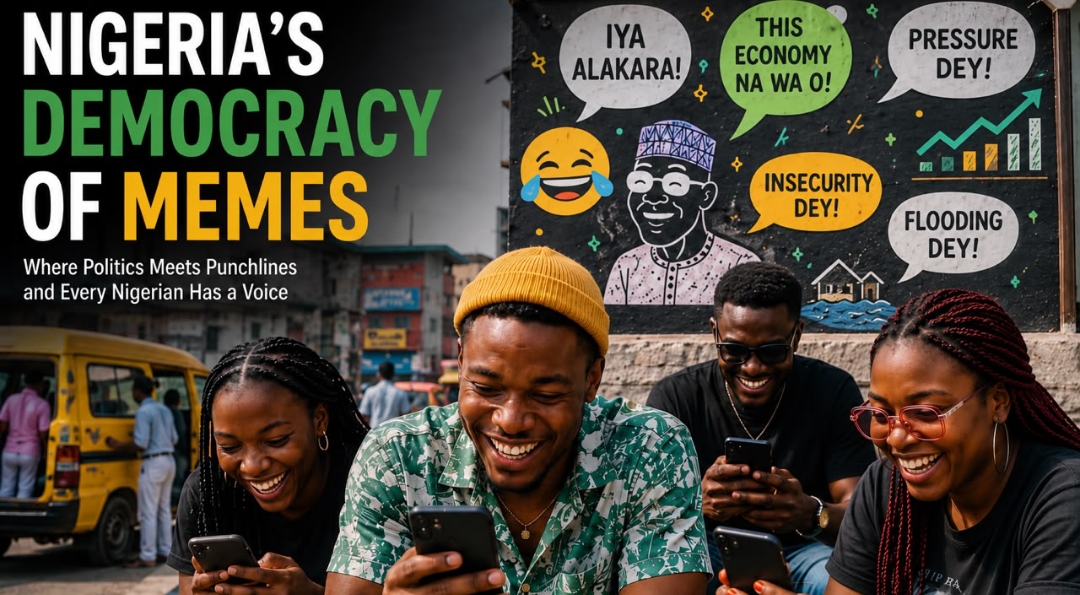
Politics in Nigeria no longer ends when the microphones are switched off. In many ways, that’s when a new conversation begins.
A presidential speech, a governor’s remark or a lawmaker’s outburst can dominate headlines for a few hours. Soon after, social media takes over. Within minutes, screenshots become memes, speeches are remixed into skits, and ordinary Nigerians turn political moments into content that is shared thousands of times.

It’s a pattern that has become almost predictable. Before analysts finish dissecting what was said, the internet has already decided how it will remember it.
The recent wave of reactions to President Bola Tinubu’s “Iya Alakara” remark is a reminder of just how quickly political moments can evolve into internet culture. What began as a passing comment soon inspired jokes, edited videos and humorous takes across social media, with users adding their own creative twists to the phrase.
It wasn’t just about the words. It was about how Nigerians chose to respond.
This isn’t new. Over the years, countless political moments have followed the same path. A serious event happens, Nigerians react, and humour becomes the bridge between politics and everyday life. That says something about the country.
For many Nigerians, memes are more than entertainment. They are a way of participating in national conversations. Not everyone has access to television debates or newspaper opinion pages, but almost anyone with a smartphone can join the discussion through a funny post or a clever caption.
Sometimes, a meme says what thousands of words cannot.
Humour has also become a coping mechanism. In a country where many people face rising living costs and other daily pressures, laughter offers a brief escape. It doesn’t erase the problems, but it makes them easier to talk about.
Social media has only strengthened this culture. Platforms like X, TikTok, Facebook and Instagram have turned everyday Nigerians into commentators, comedians and critics. A viral meme can shape public opinion just as quickly as a news report, especially among younger audiences who consume much of their information online.
But there is a downside.
Not every joke is harmless. As memes spread at lightning speed, context is sometimes lost. Satire can be mistaken for fact, and misinformation can travel under the cover of humour. What starts as comedy can easily become confusion if people stop questioning what they see.
Still, the influence of memes on Nigeria’s political conversation cannot be ignored.
They capture the public mood, hold leaders accountable in unconventional ways and preserve moments that might otherwise fade from memory. In today’s Nigeria, the internet doesn’t just react to politics, it helps shape how politics is remembered.
Perhaps that’s why every public official now speaks to two audiences: the people gathered at the event and the millions waiting online, ready to turn the next headline into the next viral meme.
In Nigeria’s digital age, democracy is no longer confined to ballot boxes and campaign rallies. It also lives in hashtags, comment sections and memes where laughter often says as much about the nation as the politics itself.
