

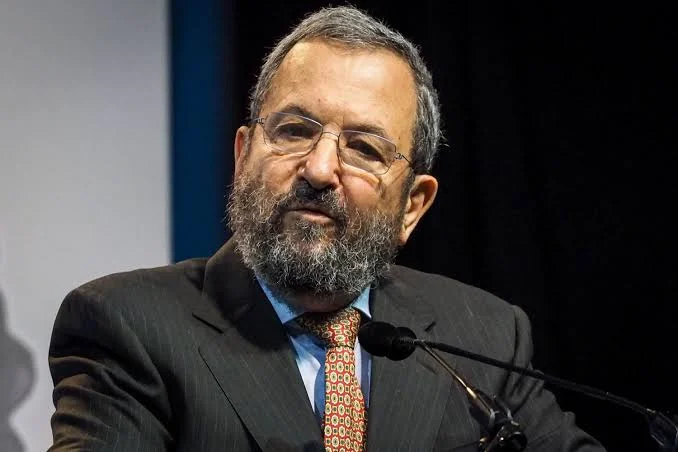
Former Israeli Prime Minister Ehud Barak has advised the Federal Government to create a centrally controlled rapid deployment police unit that can reinforce state police commands whenever they face major security emergencies.
Barak made the recommendation during an interview with Arise Television on Thursday.
He said Nigeria’s newly adopted state police system would only succeed if there was effective coordination, transparency and information sharing between state commands and the Federal Government in Abuja.
According to him, the arrangement should not result in state police operating independently without collaboration with the central government.
He said, “The fact that there is a state police for every government, under every government, doesn’t mean that there is no coordination, correlation, and dialogue with Abuja.
“In Abuja, the federal government should have an access to information. There should be certain transparency of what happens in every state police out of the certified different ones.”
Barak added that a centrally controlled police unit should be available to support state commands whenever security threats exceed their operational capacity.
He said, “There should be, to the best of my judgment, a central kind of rapid deployment police force under the command of Abuja that could be sent in any region, any one of the other police states, to support them when a problem which is beyond their capabilities emerges.
“That should be part of the picture, and it creates certain dependency of the state police in a real emergency when it goes beyond their size and their means. They call upon the central federal government to send this rapid deployment police force.”
The former Israeli leader stressed that cooperation between the Federal Government and state police should be mutual. While state commands must remain transparent about their operations, Abuja should also respond promptly to emerging security challenges across the country.
He said, “There should be a dialogue on two direction. The state should report, there should be no secrets of what happens at police, what on the mission, what they’re executing for the federal authorities.
“And at the same time, the federal authorities should be sensitive to the needs which are changing from time to time, or sometimes appearing in several regions simultaneously and need certain judgment of priorities.”
Barak noted that Nigeria faces several security threats, including Boko Haram, armed criminal groups and separatist agitations. He warned that relying on the military for routine policing often creates challenges because soldiers are trained for combat rather than law enforcement.
He said, “In my experience, army people is much less focused. They do not really understand their doctrine, their manners, their culture. Their culture doesn’t fit into law enforcement force.
“When you send a soldier into a mission which is more typical to police, there are some unintended consequences and a lot of complications.”
He, however, said military intervention becomes necessary when terrorist groups seize territory and begin operating like “mini sovereigns.”
He said, “When you have to fight a terror organisation to behave like mini sovereigns in some area that they took over, in some weak population, the communities that they are using and enslave in a way, or collect taxes or try to have a kind of rudimentary governing event, that’s probably need the army at the end, and you also have the army. So it’s a delicate issue.”
Barak commended Nigeria’s efforts in tackling terrorism, organised crime, kidnapping and separatist activities while maintaining democratic governance.
He said, “We admire the way that Nigeria is facing so many challenges in terror, in organised crime, kidnapping, in attempts to intervene, to even think of a separatist idea.
“And the way that you are doing it while speaking to the commitment to hold it through a democratic system is something that raises admiration.”
Speaking on intelligence gathering, Barak said Israel built its security capabilities over several decades and advised Nigeria to remain patient while strengthening its intelligence and security systems.
He said, “From abroad, it seems that you are making the right steps in improving both intelligence and technology and support for the police and the armed forces. And you are going in the right direction, but it’s a process. It doesn’t come overnight. In Israel, it took decades for us to develop these elements to reach this kind of excellence.”
Reflecting on his security experience, Barak recalled leading the rescue of passengers aboard a hijacked Sabena aircraft at Ben Gurion Airport, where current Israeli Prime Minister Benjamin Netanyahu was slightly wounded during the operation.
He said, “I personally led a rescue raid on a hijacked Sabena airplane that was hijacked to Ben Gurion Airport. There were more than a hundred passengers there and the hijackers had those weapons.
“When we stormed it, it took some 90 seconds, because before the shooting was over, we killed two of the terrorists and arrested the other ones and saved all the passengers, but one. We had only one young officer slightly wounded. His name was Benjamin Netanyahu.”
Barak also recalled leading a covert raid in Beirut against Fatah leaders linked to the 1972 Munich Olympics massacre and later helping to plan the Entebbe hostage rescue mission.
He said, “A year later, I led 15 commandos into the heart of Beirut to eliminate three terror leaders of the Fatah movement, those who were responsible for the massacre of Israeli athletes in the 1972 Munich Olympic Games.
“Within seven minutes of intensive shooting, we killed the three people. We completed this within 30 minutes after we landed in Beirut. Three years later, I found myself architect of our raid in Entebbe to release the Air France hostages.”
Despite Israel’s achievements, Barak acknowledged the country has also faced setbacks, including organised crime and rising killings within its Arab communities.
He said, “Even in Israel, first of all, we had also failure, where usually people know about the successes, but we had also very painful failures along the way. There are deep problems of organised crime that are not solved. This year and the previous year, there’s an unprecedented level of people murdered within the Arab society. Most of the people are murdered as a result of conflicts between different organised crime gangs and a deeply rooted culture of revenge.”
He added, “A recent decision of the government about a week ago was to order the secret service, also known as Shabak, to enter into this issue and help the police with the secret service, which has different tools, more sophisticated tools to follow people or to understand what happens in organised crime gangs. We all pray and wish that it will succeed, but no one can secure it.”
Barak urged Nigeria to remain committed to long-term security reforms, stressing that even Israel continues to learn from its challenges after decades of statehood.
He said, “We seem from afar to be ideal, but we still have to learn, and we learn from every event. We try to honestly analyse our mistakes, what went wrong, why it went wrong, what should be corrected, and try to correct it toward the next event.
“We have had two intifadas, which were quite long, painful struggles that took years to overcome. No one can promise us that it won’t repeat itself in the coming future.”
He concluded, “It might take more time to you, because you start with a vast country. We have a miniature country in terms of what you are facing, and it will be a long march. But even a long march starts with one step, and it should be done. I believe that you are doing it.”
