

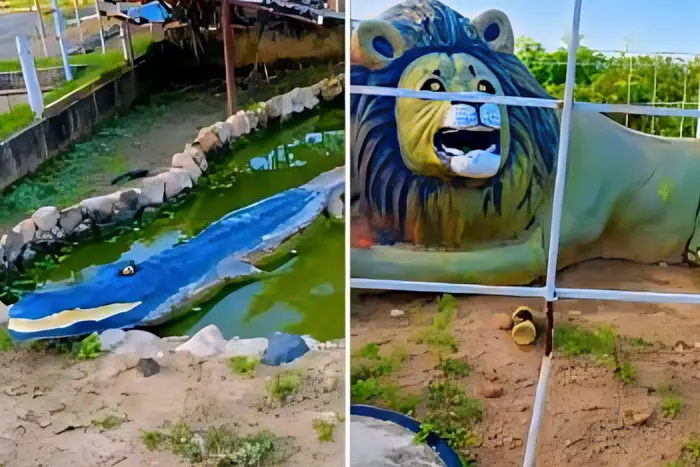
A family’s visit to a zoo in Yola, Adamawa State, has attracted attention online after they reportedly paid ₦500 each for admission, only to discover cement sculptures of animals inside some of the enclosures.
The family had apparently expected to see live animals during their visit. However, a video from the outing showed painted statues resembling a crocodile and a lion positioned behind the zoo’s fences.

The unusual experience has generated laughter and reactions online, while also raising questions about the state of zoo facilities, maintenance and funding across Nigeria.
In the viral video, a woman and a child are seen approaching what initially appears to be a crocodile enclosure.
“The first thing that welcomed us is this crocodile,” the person recording the video says.
The family soon realised that the animal was not real but a cement sculpture.
The camera later moves to another enclosure containing a painted lion statue. “Hello, lion,” the narrator says before adding, “Yola, why now?”
The narrator also questioned the ₦500 admission fee, saying, “₦500 to build this. In this economy.”
The video has amused many Nigerians, particularly because of the moment the family discovered that the seemingly realistic crocodile was actually made from cement.
However, beyond the humour, the incident has drawn attention to the broader challenges facing zoos and wildlife facilities in Nigeria.
Visitors paying to enter a zoo would ordinarily expect to see living animals, although statues and other decorative features can form part of a wildlife facility. They cannot, however, serve as a substitute for the actual experience of seeing live animals.
The situation also raises questions about whether such a low admission fee can realistically support the operation of a properly maintained zoo.
Running a zoo requires substantial resources. Live animals need regular feeding, veterinary care, clean water, secure enclosures, trained handlers, sanitation, security and continuous maintenance.
These costs can quickly become significant, making it difficult for a facility to operate sustainably on very low entrance fees alone.
While visitors may understandably feel disappointed after paying to see wildlife and encountering concrete sculptures instead, the situation also highlights the need for adequate funding and proper management of zoos.
A ₦500 entrance fee may make a facility accessible to families, but it is unlikely to be sufficient on its own to sustain a modern zoo that provides adequate care for live animals.
At the same time, financial limitations should not result in visitors being misled about what they will find at a facility advertised as a zoo.
If a zoo cannot maintain live animals, visitors should be clearly informed about the nature of the attraction before paying an entrance fee.
Where such facilities are owned or managed by public authorities, there is also a need for appropriate funding, monitoring and standards to ensure that they serve their intended purposes.
Beyond entertainment, zoos can play an important role in wildlife conservation and education by helping people, particularly children, learn about animals and develop an appreciation for protecting wildlife.
Click the link to watch the video.