

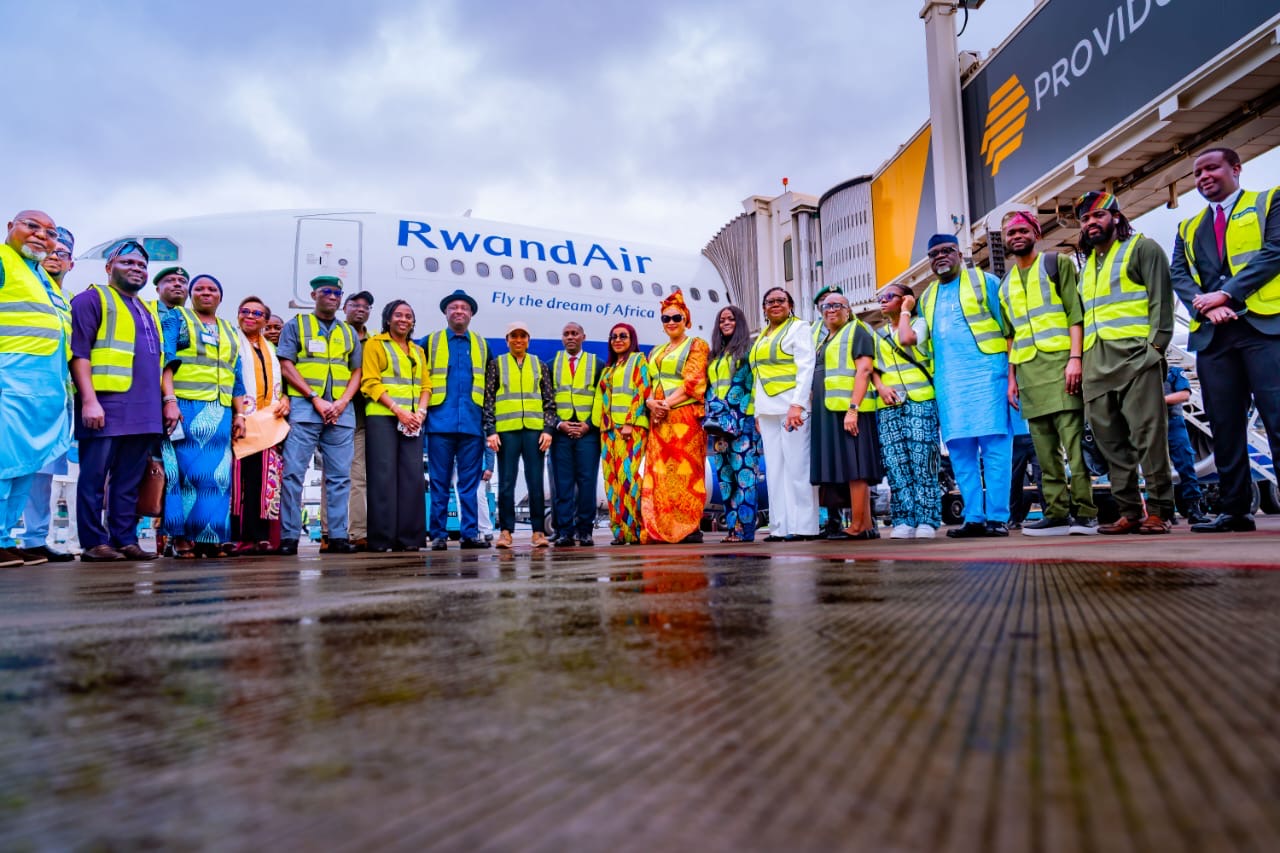
The federal government has launched an expanded air cargo corridor linking Nigeria with key markets in East and Southern Africa through a new partnership with RwandAir.
The move aimed at reducing export costs, improving market access and deepening the implementation of the African Continental Free Trade Area (AfCFTA).

The initiative, unveiled in Lagos by the Federal Ministry of Industry, Trade and Investment at the weekend, opens new export routes from Nigeria to Kigali in Rwanda, Lusaka in Zambia and Harare in Zimbabwe, while also providing Nigerian exporters with additional cargo options to Nairobi, Kenya, and Johannesburg, South Africa.
Officials said the partnership is expected to significantly lower the cost of transporting Nigerian goods across the continent, with cargo rates on routes operated by RwandAir set at less than $2 per kilogram for exporters holding AfCFTA Certificates of Origin issued by the Nigeria Customs Service.
The expanded corridor forms part of the administration’s efforts to translate AfCFTA commitments into practical opportunities for businesses under President Bola Ahmed Tinubu’s Renewed Hope Agenda.
Industry stakeholders noted that prior to the introduction of the corridor, many Nigerian exporters faced freight charges ranging from $3 to as much as $10 per kilogram for shipments to East and Southern African destinations. The high logistics costs often reduced the competitiveness of Nigerian products and limited access to regional markets.
Speaking at the flag-off ceremony, the Minister of Industry, Trade and Investment, Jumoke Oduwole, described the partnership as another important step toward making continental trade more accessible for Nigerian businesses.
According to her, the government remains focused on removing barriers that hinder trade and creating practical pathways for businesses to expand beyond Nigeria’s borders.
“Our goal is clear: to make it easier and cheaper for Nigerian businesses to trade across Africa,” Oduwole said.
“One year ago, we launched this corridor to solve a real problem for exporters — the high cost of moving goods into African markets. Today, with RwandAir, we are widening that corridor, opening more routes, and giving our exporters more options to compete.
“With eight businesses receiving AfCFTA Certificates of Origin today, we are also showing that this is not just about policy — it is about real businesses, real exports and real market access. This is AfCFTA in action.”
She explained that the corridor is expected to benefit exporters operating in high-growth sectors such as agribusiness, fashion and textiles, cosmetics, processed foods, light manufacturing and other Made-in-Nigeria products.
The minister added that improved logistics and lower transportation costs would support the government’s broader agenda of industrialisation, export diversification and increased non-oil foreign exchange earnings.
Also speaking at the event, Director of Cargo Services at RwandAir, Jean Bosco Gakwaya, said the partnership would strengthen trade links between African economies and provide businesses with more efficient access to regional markets.
“This partnership between RwandAir Cargo and Nigeria’s Federal Ministry of Industry, Trade and Investment enables us to connect Nigerian manufacturers to key markets across East and Southern Africa using our RwandAir network,” he said.
“This is a pivotal moment for intra-African trade and for how we move goods across the continent. Our ability to efficiently connect businesses to markets across regions reinforces the role of air cargo in Africa’s economic development.”
The agreement also highlights growing economic cooperation between Nigeria and Rwanda. Government officials linked the development to recent engagements between President Tinubu and Rwandan President Paul Kagame during the 13th Africa CEO Forum held in Kigali in May 2026.
The Nigeria-East and Southern Africa Air Cargo Corridor was initially launched in 2025 through a partnership with Uganda Airlines, providing exporters access to Entebbe, Nairobi and Johannesburg. With the addition of RwandAir, the network now extends to more destinations and offers exporters greater flexibility in moving goods across the continent.
Officials believe the expanded corridor will strengthen regional value chains, enhance trade efficiency and position Nigerian products more competitively within African markets at a time when countries are seeking to maximise opportunities under AfCFTA.
The Ministry acknowledged the contributions of several agencies and development partners that supported the initiative, including the Federal Ministry of Aviation and Aerospace Development, the Nigeria Customs Service, the Nigerian Export Promotion Council, the Federal Airports Authority of Nigeria, the Nigerian Shippers’ Council, freight forwarding groups, business associations and the United Nations Development Programme’s Regional Bureau for Africa.
The government urged exporters, logistics operators, business associations and micro, small and medium-sized enterprises (MSMEs) to take advantage of the new corridor to expand their footprint across Africa.
With lower freight costs, expanded route options and streamlined access to key markets, the initiative is expected to provide a significant boost to Nigeria’s non-oil export drive while advancing the continent’s ambition for deeper economic integration under AfCFTA.
