

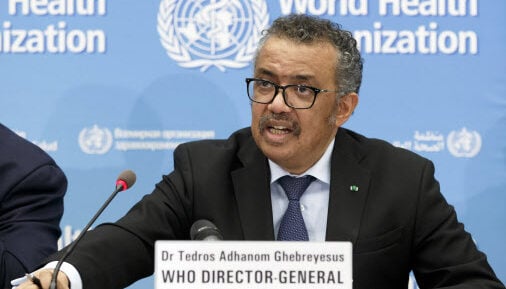
The Director-General of the World Health Organization, Dr. Tedros Ghebreyesus, has said efforts to contain the Ebola outbreak in the Democratic Republic of the Congo are beginning to keep pace with the disease’s spread.
Speaking during a press briefing on Wednesday, Ghebreyesus revealed that he recently visited the DRC, where he held meetings with political leaders, health officials, development partners, ambassadors, frontline health workers, community representatives and traditional leaders.

He disclosed that the country has recorded 344 confirmed Ebola cases, including 60 deaths, across 24 health zones in the Ituri, North Kivu and South Kivu provinces.
The WHO chief also noted that the number of suspected cases has fallen significantly to 116, compared with more than 1,000 reported a week earlier, as health authorities work through a backlog of investigations.
He added that Uganda has recorded one confirmed death and 15 confirmed cases connected to the outbreak, including a Congolese resident who travelled through the United Arab Emirates before entering Uganda.
“In Uganda, there is one confirmed death and 15 confirmed cases, including a Congolese resident who travelled to the United Arab Emirates and then to Uganda,” he said.
Ghebreyesus further disclosed that a United States citizen who contracted the virus in the DRC is currently receiving treatment in Germany.
The WHO director-general said the organisation’s assessment of the outbreak remains unchanged, with the situation classified as a high risk nationally and regionally, but a low risk globally.
“In Budibugyo, there are new treatment centres with the capacity of 80 beds, and there are treatment units in Mongalu, Raopara, Deni, Goma, and Bukavu, and more are on the way,” he said.
“So far, six people have recovered in DRC and two in Uganda, showing that people can survive Ebola if they have access to care and go to health facilities as soon as they show symptoms, but we still face several challenges.”