

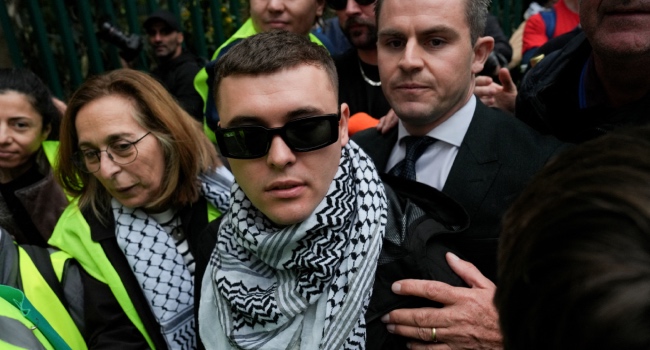
A UK court on Friday dismissed a terrorism support charge against a Northern Irish singer from the punk-rap group Kneecap, sparking celebrations among fans.
Supporters inside and outside the London courtroom erupted in cheers as the judge ruled there had been a procedural error in the case against Liam O’Hanna, declaring him “free to go”.

Speaking outside Woolwich Crown Court in southeast London, O’Hanna said the ruling proved that attempts to silence the band’s outspoken support for Palestinians had failed.
“It was always about Gaza — about what happens when you dare to speak up,” he told jubilant supporters. “Your attempts to silence us have failed because we’re right and you’re wrong.”
Authorities charged O’Hanna, 27, in May after a video from a November concert in London allegedly showed him displaying a flag of the Iran-backed Lebanese group Hezbollah. He denied the charge, filed under UK anti-terrorism laws, and his legal team argued that prosecutors had missed the filing deadline.
Chief magistrate Paul Goldspring, in a 13-page ruling, agreed with the defence, stating: “These proceedings were not instituted in the correct form. Consequently, the charge is unlawful and null. This court has no jurisdiction to try the charge.”
Belfast-based lawyer Darragh Mackin, representing O’Hanna, described the case as “political persecution masquerading as prosecution”. “This is not just a victory for Kneecap — it’s a victory for freedom of expression,” he said.
O’Hanna, who performs under the stage name Mo Chara, and his two bandmates arrived in court wearing balaclavas in the colours of the Irish flag. He wore a Palestinian keffiyeh in the dock and requested that proceedings be conducted and translated into Irish.
He had faced a single charge of displaying a flag “in such a way or circumstances as to arouse reasonable suspicion” of supporting a proscribed organisation. Since the UK banned Hezbollah as a terrorist group in 2019, showing support for it has carried a penalty of up to 14 years in prison.
O’Hanna has previously said he did not recognise the Hezbollah flag and that Kneecap’s performances are often satirical. The band insists the video was taken out of context and that they have “never supported Hamas or Hezbollah.”
Kneecap, known for criticising Israel’s war in Gaza, has faced bans in Canada and Hungary, with shows cancelled in Germany and Austria. The band also cancelled a planned US tour due to the trial.
Despite the legal battle, media attention and controversy have boosted their profile. “There’s no doubt there’s more people coming to the gigs, which obviously leads to more profit,” O’Hanna told AFP earlier this month.
The case comes amid wider debate over support for banned organisations. Hundreds have been arrested under anti-terror laws since the government outlawed Palestine Action in July, days after the group admitted to damaging an RAF base during a protest against UK military support for Israel.
Formed in 2017, Kneecap has built a reputation as daring provocateurs to their fans and dangerous extremists to their critics. Known for drug-referenced lyrics and anti-British sentiment, the group shot to international fame last year with a semi-fictional film that won several awards, including at the Sundance Festival.