

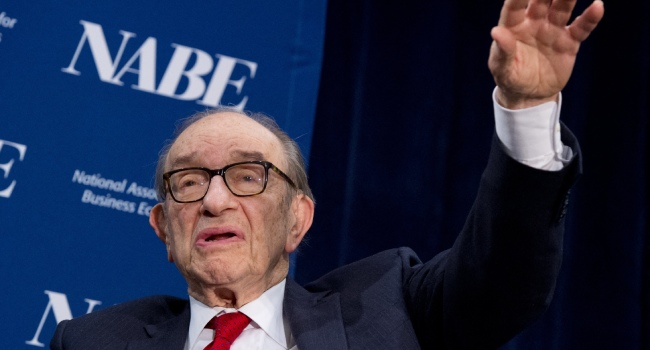
Former US Federal Reserve Chairman Alan Greenspan, one of the most influential economists in modern American history, died on Monday at the age of 100.
Greenspan, who led the US central bank for more than 18 years under four presidents, was widely credited with overseeing a prolonged period of economic growth, although he later faced criticism for policies that critics said contributed to the 2008 global financial crisis.

In a statement, the Federal Reserve said that under his leadership, the institution achieved sustained price stability that supported economic growth and strengthened public confidence in the central bank.
Greenspan’s wife, veteran NBC News correspondent Andrea Mitchell, said he died from complications related to Parkinson’s disease.
She described him as a towering figure who shaped the US economy across Republican and Democratic administrations while remaining willing to acknowledge his mistakes.
The Federal Reserve expressed deep sadness over his passing, praising his lasting contributions to monetary policy, economic thought and the institution he led as its 13th chairman.
Mitchell also reflected on her husband’s famous phrase, “irrational exuberance,” which he coined in 1996 to warn that excessive investor optimism could inflate asset prices beyond their true value. The expression became synonymous with concerns about overheated financial markets during the US economic boom of the 1990s.
She added that Greenspan had his own “irrational exuberance” for baseball, the Washington Commanders, tennis, golf and jazz music.
Born in New York City, Greenspan initially studied music before switching to economics. He was appointed Federal Reserve chairman by President Ronald Reagan in 1987, succeeding Paul Volcker, and remained in office until January 2006, serving under Presidents Ronald Reagan, George H.W. Bush, Bill Clinton and George W. Bush.