

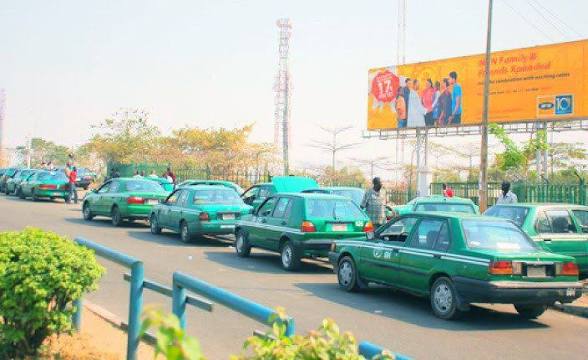
Many residents in Nigeria’s Federal Capital Territory (FCT) have switched to public transportation after the recent increase in petrol pump prices.
Low-income earners, struggling with rising transport costs, are also resorting to trekking to work to manage the financial pressure.

Findings by the News Agency of Nigeria show that usually busy routes such as the Kubwa Expressway and the Suleja–Madalla axis now record reduced traffic, especially on weekdays, as many motorists can no longer afford to fuel their vehicles.
This marks a sharp contrast to the heavy congestion and long travel delays previously experienced on these roads before the fuel price adjustment.
A public servant, Sholape Kolawole, said she has stopped using her car due to the high cost of fuel.
“It has been stressful using commercial vehicles. I have no choice since I cannot afford to fuel my car, and my salary is not enough to buy fuel every day to work.
“To cut costs, I just stopped using the car for now and resolved to taking commercial vehicles to the office and back, which is also expensive but not as much as using my car,” she said.
A commercial transporter in Kubwa village, James Obasi, said the situation is affecting small businesses and transport operations, calling for urgent government intervention.
Similarly, Emmanuel Ajayi said the difficulty in fueling his car has forced him into a stressful reliance on multiple public transport options, which is affecting his health.
A development expert, Aliyu Ilias, linked the situation to global oil market pressures and suggested that government intervention, such as supplying crude oil to local refineries at reduced rates, could help stabilize fuel prices.
He said, “One practical solution will be for the Federal Government to provide crude oil to local refineries at reduced rates, enabling them to refine and sell petrol at more affordable prices.
“Such a strategy can help stabilise fuel prices and reduce the pressure on transportation and living costs.
“The economic consequences are severe. Purchasing power has declined sharply, and disposable income has almost disappeared for many households.”
Also reacting, the National Coordinator of the Human Rights Writers Association of Nigeria, Emmanuel Onwubikor, described the situation as an “economic ambush” on Nigerians, warning of rising unemployment and social instability if urgent action is not taken.
