

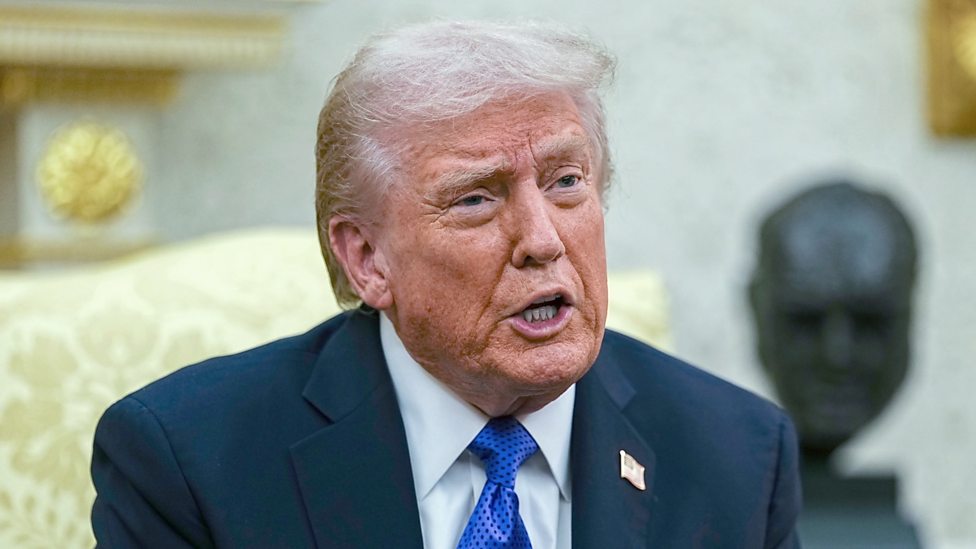
US President Donald Trump has indicated that the American naval blockade of Iran could remain in place for months, a development that helped push global oil prices to their highest levels in more than four years.
According to reports, Trump is expected to receive a briefing on potential military options involving Iran from Brad Cooper, who heads the US Central Command (CENTCOM).

The latest developments come as diplomatic efforts between Washington and Tehran remain stalled following several unsuccessful attempts at negotiations.
Trump also held a telephone conversation with Vladimir Putin on Wednesday, during which the Russian leader reportedly warned of the “damaging consequences” that could result if the United States and Israel resume large-scale military operations against Iran.
Addressing oil industry executives, Trump argued that the naval blockade was proving more effective than military strikes in pressuring Tehran.
“They are choking like a stuffed pig. And it is going to be worse for them,” Trump told Axios.
CENTCOM announced that it had successfully redirected another commercial vessel attempting to breach the blockade, describing the action as a significant operational milestone.
The command further claimed that 41 tankers carrying approximately 69 million barrels of oil remain unable to export Iranian crude, estimating the value of the stranded cargo at more than $6 billion.
Oil Prices Surge
The continued tensions sent oil markets sharply higher.
Brent crude briefly surged more than seven per cent to $126.41 per barrel, while West Texas Intermediate climbed to around $110.31 per barrel before both benchmarks later surrendered part of their gains.
The market reaction reflects growing concerns over disruptions to global energy supplies, particularly around the Strait of Hormuz, through which roughly one-fifth of the world’s oil shipments normally pass.
Iran has sought to use its influence over the strategic shipping route as leverage in negotiations, while insisting that any agreement must include an end to the US-led blockade.
Tensions With Germany
Trump also criticised Friedrich Merz, threatening to reduce the number of American troops stationed in Germany following Berlin’s refusal to support military action against Iran or contribute to a peacekeeping force in the Strait of Hormuz.
Merz had earlier accused Iran of “humiliating” Washington during negotiations, remarks that reportedly angered the US president.
Senior American officials, including Vice President JD Vance, have reportedly abandoned recent efforts to engage Iran diplomatically, amid uncertainty over who currently holds decision-making authority in Tehran following the deaths of several senior leaders in Israeli strikes.
Economic Impact and Regional Tensions
The conflict is increasingly raising concerns about its global economic consequences.
The United Nations Development Programme warned that rising energy and fertiliser costs linked to the conflict could push more than 30 million people into poverty across 160 countries.
UNDP chief Alexander De Croo described the situation as “development in reverse”.
Within Iran, the national currency has continued to weaken sharply against the US dollar, adding to economic pressures on ordinary citizens.
Meanwhile, violence has persisted on the Lebanese front despite a ceasefire between Israel and the Iran-backed Hezbollah.
The Lebanese Armed Forces reported that Israeli strikes this week wounded two soldiers and killed another in southern Lebanon.
Lebanese President Joseph Aoun urged Israel to fully implement the ceasefire, arguing that negotiations remain the only viable path to long-term security.
A recent UN-backed assessment also warned that more than 1.2 million people in Lebanon could face acute food insecurity as a result of the continuing conflict.