

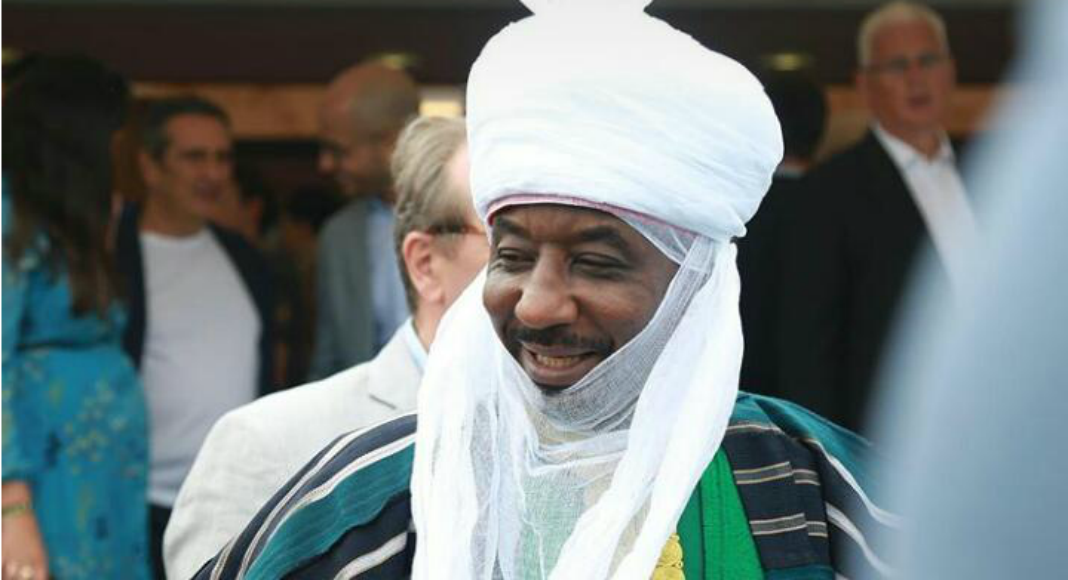
The Emir of Kano, Muhammadu Sanusi, has revealed that former President Goodluck Jonathan’s administration decided against removing the fuel subsidy in 2011 due to security concerns during the height of the Boko Haram insurgency.
Sanusi, who served as Governor of the Central Bank of Nigeria (CBN) from 2009 to 2014, made the disclosure at the Oxford Global Think Tank Leadership Conference in Abuja on Tuesday. He asserted that Nigeria’s current economic hardship stems from the failure to abolish the subsidy more than a decade ago.

“The only reason the government compromised at that time and reduced subsidy removal from 100 per cent to 50 per cent was Boko Haram. Thousands of Nigerians were protesting in the streets of Lagos, Kano, Kaduna, and other cities. The authorities feared that a suicide bomber could target the demonstrators, causing mass casualties. At that point, the issue would no longer have been about fuel subsidy,” he explained.
Sanusi nonetheless commended Jonathan’s determination to push through the reform. “You must give President Jonathan credit. He was resolute about removing the subsidy, but eventually, the government compromised to protect Nigerian lives,” he said.
He further noted that if the subsidy had been removed in 2011, the economic pain would have been far milder than what citizens face today. “Had Nigerians supported the Jonathan government then, the hardship would have been only a fraction of what we are enduring now. The delay caused this severity,” he stated.
Sanusi added that the Central Bank had already analysed the economic implications at the time. “We had worked out the figures at the CBN. I staked my credibility and said, ‘Remove the subsidy now. Inflation will rise from 11 per cent to 13 per cent, and I will bring it down within a year,’” he recalled.
According to him, Nigeria would not be struggling with inflation above 30 per cent today had the policy been implemented earlier. “There’s a sense of poetic justice — those who led the Occupy Nigeria protests have now inherited the problem and been forced to tackle it,” he remarked.
In his inaugural address on 29 May 2023, President Bola Tinubu announced the end of Nigeria’s decades-old fuel subsidy, originally introduced in the 1970s to keep fuel affordable but which had become a major drain on public finances.
Tinubu’s move, supported by international institutions, aimed to stabilise the economy but triggered sharp increases in fuel, transport, and food prices, deepening the cost-of-living crisis. By 2024, inflation had exceeded 30 per cent, and nearly half of Nigerians were living in poverty.
While critics argue that the policy has intensified hardship, supporters maintain that it was a necessary step towards restoring fiscal balance and achieving long-term economic stability.