

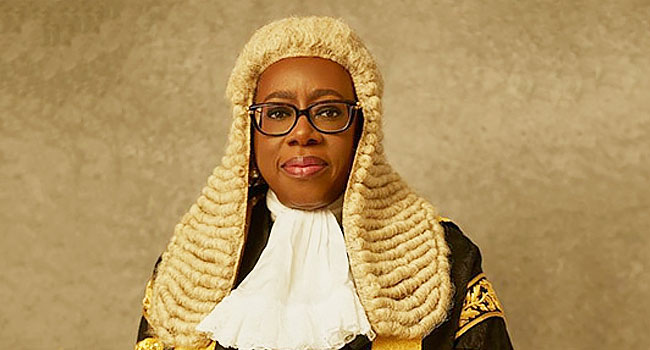
Chief Justice of Nigeria, Kudirat Kekere-Ekun, has called for greater representation of women in leadership positions within the judiciary, arguing that increased gender inclusion would significantly strengthen justice delivery and public trust in legal institutions.
Speaking at the opening ceremony of the International Association of Women Judges African Conference in Abuja, the CJN said excellence in the administration of justice requires a careful assessment of how gender equality intersects with the legal system.

According to her, “The full and effective participation of women within the judiciary has far-reaching implications for justice delivery. From broadening jurisprudential perspectives to reducing unconscious biases and strengthening public confidence in legal institutions, the presence of women on the bench enriches the administration of justice in meaningful ways.”
Justice Kekere-Ekun acknowledged progress in the representation of women within judiciaries globally but noted that more work is needed, particularly in leadership and top decision-making positions.
“While notable gains have been made, particularly at entry and intermediate levels, significant work remains to be done in ensuring equal representation within leadership positions and at the highest levels of judicial decision-making.
“The pursuit of gender equality within the judiciary is not merely a matter of representation; it is fundamentally a matter of institutional legitimacy. A judiciary that reflects the diversity of the society it serves is better positioned to command public confidence and to appreciate the varied experiences that come before it.
“Diversity strengthens judicial deliberation, enriches legal reasoning, and ultimately enhances the quality of justice delivered.”
She further stressed that the judiciary must not be limited by the same inequalities it seeks to address.
“The judiciary, like many institutions, emerged from historical structures that offered limited opportunities for women. While considerable progress has been achieved, we must remain vigilant to ensure that our institutions are not constrained by the very inequalities they are called upon to remedy.
“Ultimately, gender inclusion must be viewed as an indispensable component of the judiciary’s commitment to fairness, equality, and the rule of law.”
The CJN also advocated stronger mentorship programmes to nurture future judicial leaders.
“In the same vein, we must encourage strategic and enduring mentorship initiatives that create pathways for continuity, sustainability, and intergenerational impact. Those who have attained positions of leadership bear a responsibility to inspire, support, and guide those who follow.
“The success of any institution is not measured solely by the achievements of its present leaders but also by its capacity to prepare the next generation to surpass them.
“We must therefore embrace a culture of collaboration and mutual support, recognising that the strength of the judiciary is built collectively rather than individually.”
She added that African judiciaries share common aspirations, including judicial independence, access to justice, ethical leadership, efficient case management and public trust, noting that the conference offered an opportunity to advance those goals collectively.
Also speaking at the event, Nigeria’s First Lady, Oluremi Tinubu, described the conference theme, “Promoting Excellence in the Administration of Justice,” as both timely and relevant.
She urged participants from across Africa to continue building transparent, compassionate and rule-based judicial systems.
“At a time when societies across the world are advancing through new legal, technological, and social developments, the pursuit of excellence within our justice system remains both an obligation and a moral imperative.
“The judiciary remains central to sustaining the rule of law in a democratic society, serving as the institution where justice and fairness are upheld and the rights of citizens are protected.
“The presence of women on the bench adds value to the judicial system by broadening perspectives and deepening understanding in the dispensation of justice.”
The First Lady praised women judges across Africa for breaking barriers and creating opportunities for future generations in the legal profession.
“As a former senator of the Federal Republic of Nigeria, I understand the challenges women face while aspiring for leadership positions. This is why I remain committed to initiatives that promote equitable access to opportunities for women and girls and strengthen our democracy.”
The Attorney-General of the Federation, Lateef Fagbemi, represented by Solicitor-General Mrs. Beatrice Jedy-Agba, said women judges play critical roles beyond the courtroom and reaffirmed Nigeria’s commitment to judicial reforms that promote gender inclusion.
He maintained that the country had already made progress through the appointment of women to key public offices.
In his goodwill message, Nyesom Wike said the administration of President Bola Tinubu would continue investing in infrastructure to support the justice sector and improve the welfare of judicial officers.
Wike disclosed that the Federal Government had constructed more than 400 residences for judicial officers in Abuja, insisting the initiative was driven by governance objectives rather than politics.
“We are not playing politics with justice,” he said.
Earlier, President of the Court of Appeal and President of the National Association of Women Judges of Nigeria, Monica Dongban-Mensem, said the judiciary must continue to uphold integrity, competence, fairness and accountability amid evolving legal and technological challenges.
“The Women Judges of Nigeria, as host of this important regional gathering, remain firmly committed to advancing judicial capacity, promoting gender equality within the judiciary, and fostering collaboration among women judges across Africa and beyond,” she said.
The conference attracted judicial leaders from across Africa, including serving and retired Supreme Court justices, Court of Appeal justices, High Court judges, the President of the Nigerian Bar Association, and other dignitaries.
