

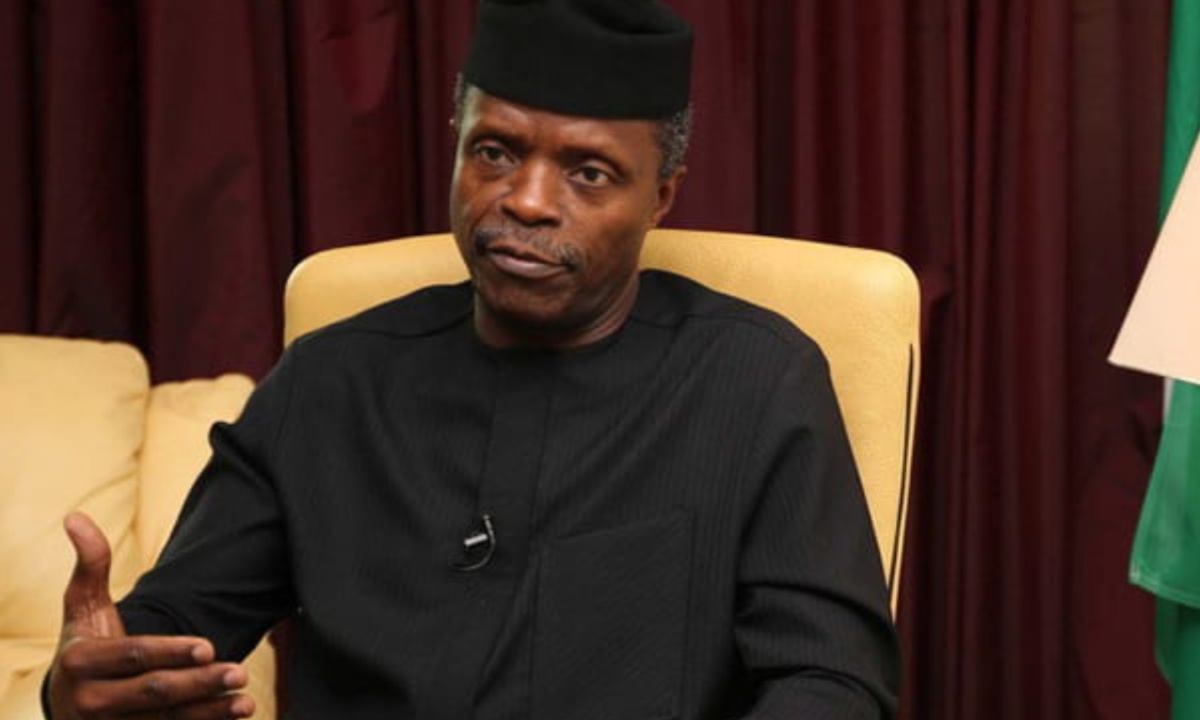
Former Vice President Yemi Osinbajo has appealed to the Federal Government to create a thorough national plan to confront Nigeria’s escalating Internally Displaced Persons crisis.

Speaking through his former Chief of Staff, Ade Ipaye, at the 10th House of Justice Summit in Kaduna on Friday, themed “From Camp to Justice,” Osinbajo noted that more than 3.4 million Nigerians—mainly women and children—have been displaced due to insurgency, communal violence, and natural disasters.
He cautioned that issues such as overcrowded camps, malnutrition, and limited access to education could lead to long-term harm if immediate steps are not taken.
“The scale of displacement has become a national emergency. We need a coordinated approach covering emergency support, rehabilitation, and reintegration.”
“Displacement is not just a humanitarian challenge; it is a threat to the social fabric and the future of our children. We cannot afford piecemeal solutions,” Osinbajo said.
He praised the House of Justice for dedicating the summit to IDP issues and encouraged government bodies, civil society, and global partners to collaborate on realistic and effective measures.
Prof. Dakas Dakas (SAN), Chairman of the Nigeria Law Reform Commission and keynote speaker, emphasised the importance of domesticating the Kampala Convention, which outlines protections for IDPs.
“Without domestication, our displaced citizens remain legally unprotected. They are trapped in a policy vacuum,” he said, calling Nigeria’s current IDP policy “outdated and legally weak.”
Dakas pointed to problems such as weak institutional coordination, insufficient funding, and poor legal structures, which have left displaced people in “precarious and vulnerable” situations.
He underscored the need to move “from camps to justice,” supporting safe returns, local integration, and structured resettlement.
“Justice for IDPs is not optional. It is essential for peace and national cohesion. We must ensure accountability for perpetrators of displacement, legislate IDP rights, and establish budgetary allocations to support them,” he said.
He also advocated for a national reparations fund, inclusion of IDPs in elections to avoid disenfranchisement, and better data-gathering systems.
“Accurate data is critical. The National Population Commission must regularly survey IDPs and integrate them into census exercises. Without data, there can be no meaningful planning,” he added.
Gloria Ballason, Chief Executive Officer of the House of Justice and the summit’s convener, criticised existing government policies, arguing that they prioritise rehabilitating insurgents instead of delivering justice to victims.
She outlined the scale of displacement and devastation in Kaduna, Plateau, Benue, Zamfara, Niger, and Kwara states, stressing that current non-kinetic initiatives such as Operation Safe Corridor and DDRR have failed to reduce violence.
“Victims need justice, reparations, and psychosocial healing. They need a safe return to their communities. Investing only in insurgents risks normalising terrorism,” she said.
The summit held a minute of silence for Nigerians killed in various attacks and renewed demands for swift action on justice, resettlement, and national healing.
“This is a pivotal moment. Our response to the plight of IDPs will define Nigeria’s moral and political future. We must act now,” Ballason concluded.
