

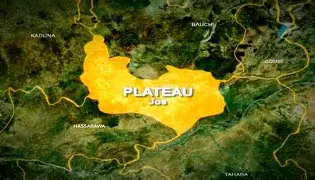
Chairmen of the 17 local government areas in Plateau State have agreed to establish officially registered security outfits to support conventional security agencies in tackling killings and other security threats across the state.
The Commissioner for Local Government and Chieftaincy Affairs, Ephraim Usman Gar, revealed this on Thursday during a press conference in Jos, where he presented findings from the ministry’s inspection of projects across the state.

Speaking alongside the 17 council chairmen, Gar said the local governments had agreed to replicate the security model adopted by Wase Local Government Area to strengthen security at the community level.
He said, “Right now, we have Wase LGA that has trained its own personnel. But it is just a matter of time before other LGAs follow suit, and they have all agreed that they are going to take a cue to have a formal security outfit that will help our conventional security agencies combat crimes within our society.”
According to him, personnel of the Wase security outfit received three months of training facilitated by the Nigeria Security and Civil Defence Corps (NSCDC).
He added that officially registering the outfits would enhance information sharing and strengthen cooperation between local security operatives and conventional security agencies.
Gar referenced the Wase Rock Security Network Limited, which recently graduated 140 officers after completing their training. The personnel also participated in a passing-out parade organised by the council chairman, Hamisu Mohammed Anani.
As part of efforts to strengthen the outfit’s operations, 25 patrol motorcycles and two Toyota Hilux vehicles were donated to improve mobility and response to security emergencies.
“The outfit was formally inaugurated by the Plateau State Command of the NSCDC following a training programme,” he stated.
The initiative comes amid persistent security challenges in Plateau State, where several communities have continued to experience deadly attacks and killings.
Meanwhile, Gar explained that the ministry’s inspection exercise was designed to evaluate completed and ongoing projects undertaken by the 17 local government councils, assess their quality and ensure the proper utilisation of public funds.
He noted that the inspection covered the state’s three senatorial zones, adding that the ministry was impressed by the projects visited.
“Providing dividends of democracy at the grassroots remains the top priority of this administration. From what we have seen, governance has truly been taken closer to the people.
“The Chairmen have no option but to key into the vision of Governor Mutfwang, and they have justified the confidence reposed in them,” he said.
Projects inspected in the Southern Zone included the renovation of a youth centre, construction of a mini stadium, computer-based test centres, primary healthcare facilities, motorised boreholes and solar-powered streetlights.
The inspection team also visited the Wase Rock Radio and Television Station, as well as facilities at the temporary headquarters of the Nigerian Army’s 175 Infantry Motorcycle Battalion.
In the Central Zone, the projects assessed included the 23-kilometre Gugur Road in Kanke, a 1,500-capacity event hall in Mangu and a 200-capacity anatomy laboratory at Plateau State University, Bokkos, financed by the Association of Local Governments of Nigeria.
Other facilities inspected included primary healthcare centres, rural electrification projects and the palace of the Ngolong Ngas.
In the Northern Zone, the team visited healthcare centres, rural electrification projects, local government secretariats, ICT centres, markets, bridges, police outposts and town halls.
The proposed security outfits are expected to strengthen existing community-based security structures in Plateau State.
The state already operates Operation Rainbow and Neighbourhood Watch, established under the Plateau State Operation Rainbow and Neighbourhood Watch Law of 2012. Neighbourhood Watch serves as a civilian intelligence-gathering structure that supports security operations.
The proposal also comes amid renewed violence in parts of the state. At least 13 people were reportedly killed in separate attacks across Jos South, Mangu and Riyom on September 13, 2026, while another attack on communities in Mangu in August left at least 25 people dead.
