

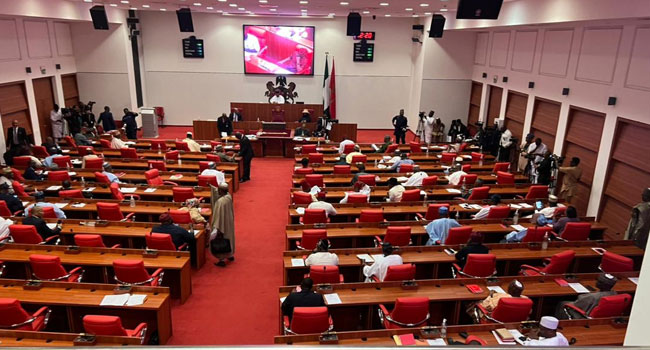
The Senate has set up a 12-member conference committee to reconcile differences between its version of the Electoral Act (Amendment) Bill and that passed by the House of Representatives.
Senate President Godswill Akpabio announced the decision on Tuesday during an emergency plenary session, explaining that the committee’s size was expanded from nine to 12 after consultations with the leadership. He then read out the names of the senators appointed to the panel.

Senator Simon Bako Lalong will serve as chairman, alongside Senators Mohammed Tahir Monguno, Adamu Aliero, Orji Uzor Kalu, Abba Moro, Asuquo Ekpenyong, Aminu Iya Abbas, Tokunbo Abiru, Niyi Adegbonmire (SAN), Jibrin Isah, Ipalibo Banigo and Onyekachi Nwebonyi.
Akpabio urged the committee to treat its assignment as urgent, expressing confidence that it could conclude its work within days, allowing President Bola Tinubu to assent to the amended bill before the end of February. He said the outcome would be transmitted promptly to the President and formally constituted the committee by striking the gavel.
The session grew tense at points, with interruptions and disagreements following a motion by Senator Monguno proposing a reversal of the Senate’s approval of Clause 60(3) of the bill, which deals with electronic transmission of election results. Akpabio backed a proposal that makes electronic transmission the primary method, while allowing manual submission with Form EC8A only where technical failures occur.
The debate prompted Senator Enyinnaya Abaribe to call for individual voting, a request he later withdrew.
The emergency sitting followed public backlash over recent amendments to the Electoral Act, particularly the removal of the requirement for real-time electronic transmission of results. The change retained provisions allowing INEC to determine the mode of transmission, sparking protests and criticism from civil society groups and opposition figures.
Akpabio has since clarified that the Senate did not reject electronic transmission, saying the adjustment aimed to avoid legal issues linked to network failures and to give INEC operational flexibility. While critics say the amendment weakens transparency, several senators maintain that the dispute concerns wording rather than opposition to electronic transmission itself.