
[Special Report] Theft, delayed deliveries: How some Lagos dispatch riders are gradually ruining booming e-commerce market

The Nigerian freight and logistics sector has recorded exponential growth in recent years. According to data from global market research and consultancy company, Mordor Intelligence, the market is currently valued at over $11 billion and is projected to exceed $15 billion by 2030.
Out of its over five subsectors including Freight transportation (road, rail, air and maritime), Warehouse and Storage, Courier, Express, and Parcel (CEP), Freight Forwarding and Value Added Services; the Courier, Express, and Parcel (CEP) appears to be one of the fastest-growing segments.

Often referred to as the last-mile delivery subsector, it focuses on the rapid, real-time delivery of smaller shipments, packages, and documents. This subsector is heavily driven by the booming e-commerce and retail trade sector. Findings by NewsClick Nigeria showed that the subsector is dominated by e-commerce platforms like Glovo, Chowdeck and Jumia. These three majorly handle food and other edible deliveries. The courier and parcel services are majorly handled by DHL and NIPOST. While Good is Good Motors (GIGM) controls a large share of the land transport and cargo space. However, this is not to rule out the presence of other players who also contribute significantly to the development of the subsector.
According to findings, most dispatch riders are under the employment of major players like Glovo, Chowdeck and DHL. The trio is reportedly responsible for about 70 per cent of employees in the sector. According to reports, Chowdeck, a leader in on-demand delivery, experienced a 1,200 per cent revenue increase between 2022 and 2023. By 2024, it surpassed N30 billion in Gross Merchandise Value, claiming profitability and securing $9 million in funding by August 2025.
Similarly, Glovo has solidified its presence, reporting a 76 per cent surge in quick commerce in Nigeria for 2024. Between 2021 and 2024, Glovo and its partners generated over N71 billion (an estimated $42 million) in revenue within the country, while global giants like DHL Group reflect a normalisation of the market, with revenues of €84.2 billion in 2024.
However, experts have repeatedly warned that a single bad experience can negatively influence customers’ loyalty, pushing them back to traditional services, whether in cooking, in-store shopping or running their own errands, which will in turn stall the growth of the service-on-demand economy.
Surge in businesses, decline in trust
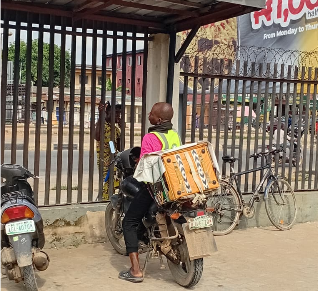
The sound of dispatch motorcycles speeding through traffic has become part of daily life in many Nigerian cities. From food and clothes to gadgets and important documents, dispatch riders now play a major role in helping businesses survive and customers get items delivered to their preferred designations quickly.
However, while the development is largely convenient and welcomed, the growing complaints about theft, partial or outright consumption, delayed deliveries, damaged items, missing packages and unprofessional conduct are raising concerns about trust and accountability in the evolving industry.
Viral videos on social media have shown different scenarios of unprofessional conducts of these riders either tampering with or consuming portions of food deliveries. There has also been cases of customers confronting the riders or having to track them to hidden locations in instances when they (riders) absconded with the orders.
When NewsClick Nigeria reached out to a number of customers for reactions on their service experience with dispatch riders and delivery companies, majority described it as terrible and non-satisfactory while calling for a strict regulation of the subsector.
Favour Irewole, a student living in Ikorodu, recounted how a dispatch rider damaged a costly flat-screen television he sold to a buyer in Ajah.
“There was this day I sold a TV to someone in Ajah while I live in Ikorodu. When the rider got to the buyer, we discovered the TV screen was broken.
I asked the dispatch rider how it happened and he said he didn’t know. The TV was working perfectly before it left Ikorodu. What pained me was that it was a costly TV and the company didn’t refund me,” Favour said.
A fashion designer, Oluwatobilola, also narrated how a dispatch rider nearly ruined an international delivery arrangement after delaying a package for several hours.
“The approximate time it was supposed to take the dispatch rider to deliver the cloth was about two hours. Could you believe that this dispatch rider used more than seven hours? I was really angry.
“I called the dispatch rider and he wasn’t responding to calls or chats. What if the person travelling had left Nigeria before the cloth arrived? I would have spent extra money sending another package abroad.”
Another dissatisfied customer, Mrs. Adebisi Olawale, a Lagos resident, said she once received a food order that appeared tampered with.
“The seal on the package was broken and resealed carelessly. When I opened it, part of the food was already missing.”
Chinedu Okafor from Oyo State also testified to once receiving a damaged package.
“The carton looked like it had been forcefully opened and retaped. Although most of the contents were inside, one item was missing,” he said.
For clothing vendor, Paul Alabi, delayed deliveries and dishonest updates from riders remain a major problem.
“That rider delayed my customer’s package for almost six hours while continuously giving false updates about his location. In fact, I eventually got to Ikotun before he did.”
Many respondents blamed both riders and dispatch companies for the growing problems, arguing that poor monitoring and weak accountability have worsened the situation.
“Some companies hire riders too quickly without proper background checks or training,” Paul added.
Poor service delivery not entire our faults – Dispatch riders
Meanwhile, some of the dispatch riders who spoke to NewsClick Nigeria said poor working conditions contribute majorly to challenges they face daily on the job.
Emeka Uche, a dispatch rider in Lagos, said traffic, fuel costs and pressure from companies affect delivery operations daily.
“The pressure from companies to complete multiple deliveries within tight timelines creates stress,” he said.
Another rider, Ibrahim Musa, blamed poor regulation and lack of proper supervision.
“Most companies do not provide structured training. Riders are often left to learn through experience,” he explained.
Some riders also admitted witnessing unethical behaviour among colleagues.
“Yes, I have seen riders collect extra money from customers without company approval,” dispatch rider Sodiq said.
Another rider, Kenneth, added that some riders allegedly open food packages or refuse to complete deliveries unless customers pay extra charges.