

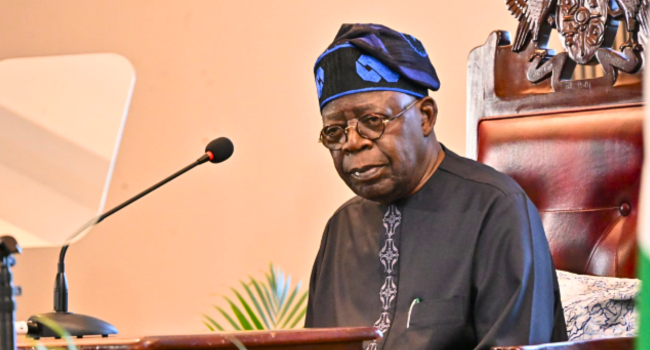
The Presidency has clarified that the ongoing Freedom of Information Act (FOIA) case involving President Bola Tinubu in the United States is a civil dispute over the disclosure of records and not a criminal proceeding.
Bayo Onanuga, Special Adviser to the President on Information and Strategy, made this clarification in a statement issued on Thursday, stressing that no US court had found Tinubu guilty of any criminal offence in connection with the case.

“For clarity, the matter is a civil records-disclosure dispute under the United States Freedom of Information Act. It is not a criminal case against President Bola Ahmed Tinubu, nor has the court found him guilty of any criminal wrongdoing,” the statement reads.
The clarification followed recent commentary surrounding the case before the United States District Court for the District of Columbia, where a dispute is ongoing over the release of records held by the Federal Bureau of Investigation (FBI) and Drug Enforcement Administration (DEA) concerning Tinubu.
Tinubu, who joined the proceedings as an intervenor, has asked the court to permit the FBI and DEA to retain redactions and withhold certain information from documents already released to Aaron Greenspan, the founder of PlainSite.
Greenspan submitted FOIA requests in 2022 and 2023 seeking records from six US government agencies relating to investigations connected to a Chicago drug-trafficking case in the early 1990s. Tinubu was one of four individuals named in the requests.
Among the materials sought by Greenspan was what he described as the “entire FBI file” on Tinubu, as well as FBI interview records dating from 1992 to 1993.
Several agencies initially declined to confirm or deny whether they possessed records concerning Tinubu, relying on a procedure known as the “Glomar” response.
In April 2025, US District Judge Beryl Howell ruled that the FBI and DEA had failed to sufficiently justify their refusal to confirm or deny the existence of records relating to Tinubu.
Howell subsequently ordered the agencies to search for and process non-exempt records covered by Greenspan’s requests.
Following the ruling, the FBI and DEA released thousands of pages of documents, some of which contained redactions. The agencies also submitted a Vaughn index explaining the basis for withholding some of the information.
Greenspan later asked the court to order additional disclosure, arguing that the agencies had not fully complied with the court’s directive.
In a response filed on August 28, Tinubu argued that some of the records should continue to be withheld or redacted, citing privacy protections under US law.
His lawyers maintained that FOIA is designed to provide information about government activities rather than expose private information gathered by government agencies about individuals.
They cited FOIA Exemption 7(C), which protects law-enforcement records where disclosure could amount to an unwarranted invasion of personal privacy, alongside provisions of the US Privacy Act.
Tinubu’s legal team also argued that Howell’s 2025 ruling, which rejected the FBI and DEA’s reliance on Glomar responses, did not remove Tinubu’s privacy rights over the contents of any investigative records.
‘IT’S A CIVIL RECORDS-DISCLOSURE DISPUTE’
Onanuga said the FBI and DEA had so far released 399 pages of records, while withholding portions under exemptions provided for under US law.
According to him, the exemptions cover issues including grand-jury proceedings, attorney-client and attorney-work-product privileges, law-enforcement information, personal privacy, confidential sources and investigative techniques.
He said Tinubu had also invoked his rights under FOIA Exemption 7(C), stressing that any decision by the court on whether particular information should be disclosed or withheld would not, on its own, establish criminal liability.
“The litigation is a civil records-disclosure dispute under FOIA. It does not constitute a criminal charge, trial, or judicial finding against President Tinubu,” he said.
The presidential spokesperson also referenced a February 4, 2003, letter from the American Consulate in Lagos to Tafa Balogun, who was then the Inspector-General of Police (IGP).
According to Onanuga, the letter stated that an FBI records check had found no criminal arrest records, wants or warrants for Tinubu, who was serving as Lagos State governor at the time.
He said the plaintiff has until September 11 to file an opposition and response to the processes submitted by the defendants and Tinubu, while the FBI, DEA and the President have until September 18 to respond.
Onanuga further rejected recent claims linking former Vice-President Atiku Abubakar and Karl Von Batten to the litigation, stating that neither individual is a party to the case.
He urged the media and the public to distinguish the ongoing court proceedings from what the Presidency described as partisan commentary.
According to him, the US court will ultimately determine whether the disputed redactions and withholdings are lawful based on the applicable law and evidence.