

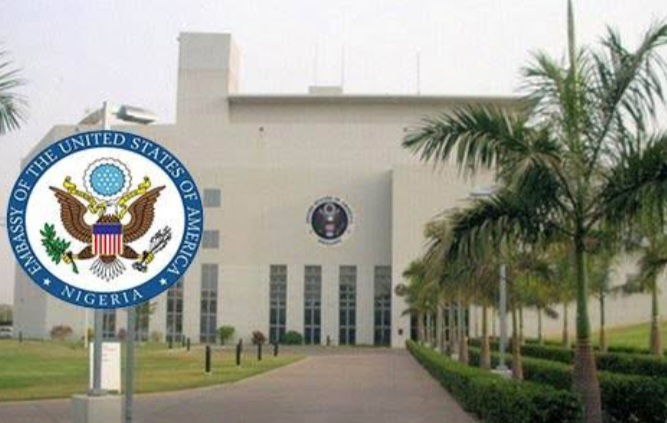
US Embassy in Nigeria cancels visa appointments amid US-Iran tensions
The United States Embassy in Nigeria has cancelled all visa appointments scheduled for Wednesday, 4 March 2026, citing a heightened risk of protests in Abuja following escalating hostilities between the United States and Iran.
In a notice published on its website on Wednesday, the embassy cautioned about “potential demonstrations” in the Federal Capital Territory and advised American citizens to remain indoors.

“The U.S. Embassy in Abuja informs U.S. citizens that there is a high potential for protests in Abuja tomorrow, March 4, 2026, due to the current conflict with Iran,” the statement read.
“Previous protests by some groups have resulted in violent clashes between the groups and Nigerian security forces. The Embassy strongly recommends that all U.S. citizens in Abuja remain in their residences on Wednesday, March 4.”
The advisory follows airstrikes reportedly carried out by the United States and Israel which targeted and killed Iran’s Supreme Leader, Ayatollah Ali Khamenei, along with several senior Iranian officials.
In response, Tehran launched multiple missiles at US military installations in Gulf states, including Saudi Arabia, pledging to avenge the death of its Supreme Leader and other regime figures.
The conflict, which began with coordinated US-Israeli strikes over the weekend, entered its fifth day on Tuesday with no indication of de-escalation.
US President Donald Trump stated on Tuesday that it was too late for Iran to seek negotiations, despite signals from Tehran suggesting an interest in dialogue.
In a post on Truth Social, Trump wrote: “Their air defense, Air Force, Navy, and Leadership is gone. They want to talk. I said ‘Too Late!’”
His comments came shortly after he had previously indicated openness to talks amid continuing joint US-Israeli military operations.
Speaking to reporters at the White House during a meeting with Friedrich Merz, Trump claimed the strikes had inflicted significant damage.
“Just about everything’s been knocked out,” he said.
He further asserted that Iran had been preparing an attack before the joint action by the United States and Israel, adding: “I think they were going to attack first, and I didn’t want that to happen. So, if anything, I might have forced Israel’s hand.”
Addressing possible outcomes, Trump warned that a worst-case scenario would be the rise of a successor similar to Iran’s late leader.
“I guess the worst case would be, we do this, and then somebody takes over who’s as bad as the previous person,” he said. “That could happen. We don’t want that to happen.”
He also claimed that two rounds of strikes had eliminated individuals previously viewed as potential successors.
However, Iran has rejected the prospect of talks with Washington. Mohammad Mokhber, a senior aide to the late Ayatollah Ali Khamenei, stated that there was “no basis for any negotiations with them”, adding: “We can continue the war as long as we want.”
Iran earlier announced plans to hold a three-day state funeral for Khamenei. According to the state news agency Irna, citizens would be able to pay their respects at the Imam Khomeini Grand Mosque in Tehran before his burial in Mashhad, his home city in north-eastern Iran.
Khamenei was 86 at the time of his death.