

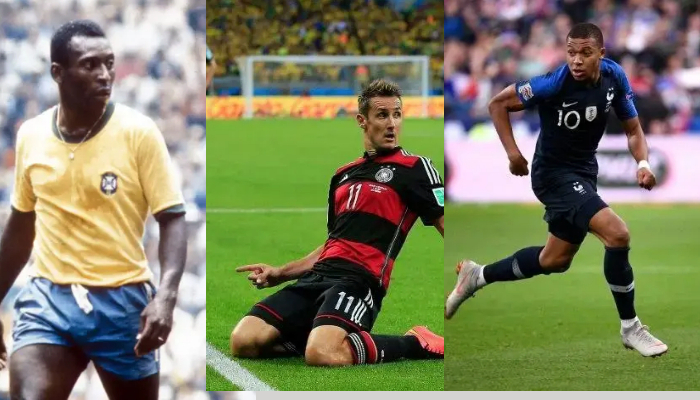
The FIFA World Cup has long been the stage where football icons are made and scoring records are etched into history. Ever since Uruguay hosted the inaugural tournament in 1930, no competition has demanded more from goalscorers. Beyond talent, success requires composure, consistency, and the ability to perform under immense global scrutiny.
Some players produced extraordinary numbers in a single tournament, while others built their reputations over several editions, returning repeatedly to showcase their brilliance on football’s biggest platform.

From Brazilian flair to German precision, from youthful prodigies to seasoned champions, these are the ten players with the most FIFA World Cup goals in history.
1. Miroslav Klose (Germany) — 16 Goals
Miroslav Klose holds the all-time FIFA World Cup scoring record with 16 goals spread across four tournaments for Germany. He completed the achievement during Germany’s victorious 2014 campaign. Renowned for his positioning and aerial strength, Klose accumulated his tally through remarkable consistency rather than one standout tournament. He scored five goals in both 2002 and 2006, added four in 2010, and finished with two in 2014. He overtook Brazilian great Ronaldo during Germany’s historic 7–1 semifinal victory over Brazil in 2014.
2. Ronaldo (Brazil) — 15 Goals
Ronaldo scored 15 goals in 19 World Cup matches, with all of those goals coming between the 1998 and 2006 tournaments, despite appearing without scoring in 1994. The former Barcelona, Inter Milan, AC Milan, and Real Madrid star won the Golden Boot in 2002 as Brazil lifted the trophy. Considered one of football’s finest strikers, O. Fenômeno combined speed, strength, and clinical finishing in a way few have matched on the World Cup stage.
3. Gerd Müller (West Germany) — 14 Goals
Gerd Müller found the net 14 times across only two World Cups, in 1970 and 1974. His goals-per-game average exceeded 1.0, the best ratio among players with more than five World Cup goals. Nicknamed “The Bomber”, Müller scored the decisive goal in the 1974 final as West Germany defeated the Netherlands. His efficiency remains one of the most impressive scoring records in football history.
4. Just Fontaine (France) — 13 Goals
Just Fontaine still owns the record for the most goals scored in a single World Cup tournament. During the 1958 edition in Sweden, he struck 13 times in only six matches. No player has equaled that achievement since. Fontaine scored in every game France played and reached the total in what turned out to be his only World Cup appearance. It remains one of the greatest individual scoring displays the competition has ever seen.
5. Lionel Messi (Argentina) — 13 Goals
Lionel Messi is level with Fontaine on 13 World Cup goals, although he required five tournaments to reach the mark. The Argentine superstar completed one of football’s most celebrated journeys by winning the 2022 World Cup in Qatar. He scored seven goals during the tournament, including two in the final, helping Argentina secure a third world title. Messi is also the only player to win the World Cup Golden Ball three times.
6. Pelé (Brazil) — 12 Goals
Pelé scored 12 World Cup goals and remains the only footballer to win three FIFA World Cups. He burst onto the world stage at just 17 years old in 1958, scoring six goals, including a hat trick in the semifinal and two goals in the final. Widely regarded as the defining player of his era, Pelé continues to serve as the standard by which football greatness is measured.
7. Sándor Kocsis (Hungary) — 11 Goals
Sándor Kocsis scored 11 goals in only five matches during the 1954 World Cup, setting a tournament record at the time and helping Hungary reach the final. That Hungarian side is often regarded as one of the greatest teams never to win the competition. The dazzling “Golden Team”, inspired by Ferenc Puskás, ultimately fell to West Germany in a surprise defeat in the final. Kocsis also scored an impressive 75 goals in 68 appearances for Hungary.
8. Jürgen Klinsmann (Germany) — 11 Goals
A World Cup winner in 1990, Jürgen Klinsmann scored 11 goals across 17 matches at three separate tournaments. He became the first player to score at least three goals in three consecutive World Cups and played a key role in Germany’s triumph in 1990. His best individual campaign came in the United States in 1994, where he netted five goals in five matches before Germany exited in the quarterfinals.
9. Kylian Mbappé (France) — 12 Goals
Kylian Mbappé is widely viewed as the strongest candidate to challenge Klose’s record. Entering the 2026 tournament at age 27, he already has 12 World Cup goals from just two editions. With realistic opportunities to feature in both 2026 and 2030, he could eventually surpass the current benchmark. His eight goals at the 2022 World Cup, including a hat-trick in the final, rank among the greatest individual performances ever seen in a championship match. The 2026 tournament offers another major chance for him to extend his lead among active players.
10. Tied — Helmut Rahn, Teófilo Cubillas, Grzegorz Lato, Gary Lineker, Gabriel Batistuta, and Thomas Müller (10 Goals Each)
Six players share the 10-goal mark in World Cup history: Helmut Rahn of West Germany, Teófilo Cubillas of Peru, Grzegorz Lato of Poland, Gary Lineker of England, Gabriel Batistuta of Argentina, and Thomas Müller of Germany.
Each left a distinct mark on the tournament. Lineker remains England’s highest-scoring World Cup player and won the Golden Boot in 1986 after scoring six goals. Cubillas represented Peru at the 1970, 1978, and 1982 tournaments. Batistuta held Argentina’s World Cup scoring record until Messi eventually surpassed him.
Who Could Challenge the Record at the 2026 World Cup?
As the 2026 FIFA World Cup unfolds, Mbappé stands out as the leading active player capable of eventually threatening Klose’s record. Meanwhile, Messi, who is expected to be playing in his final World Cup, will look to increase his total of 13 goals.
The expanded 48-team format creates additional matches and more scoring opportunities, giving players a greater chance to climb the all-time rankings. As a result, the race among the World Cup’s greatest goalscorers could become more competitive than ever before.
