

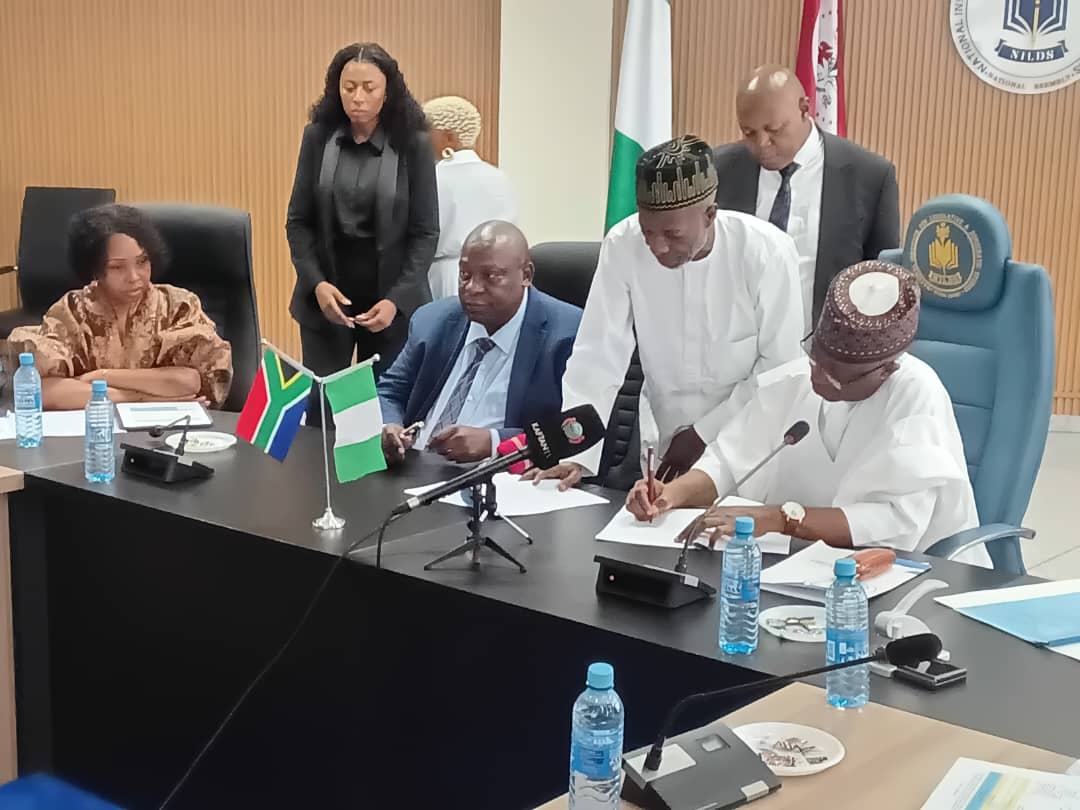
Nigeria and South Africa have moved to reinforce inter-parliamentary collaboration and democratic governance through the signing of a Memorandum of Understanding between key legislative institutions in both nations.
The agreement, formalised on Friday at the National Institute for Legislative and Democratic Studies in Abuja, is aimed at boosting cooperation, encouraging knowledge sharing, and strengthening institutional capacity between Nigeria’s legislative support body and South Africa’s Gauteng Provincial Legislature.

This development comes amid increasing calls for stronger intra-African collaboration, particularly in harmonising legislative frameworks to support continental initiatives such as the African Continental Free Trade Area.
Speaking during the event, South Africa’s High Commissioner to Nigeria, Bobby Moroe, described the pact as a significant milestone in bilateral relations.
Moroe, who was represented by Lindi Mminele, said, “I believe this groundbreaking benchmarking will strengthen existing relations between the governments of South Africa and Nigeria, and also include the supporting institutions.
“Gauteng is our economic hub. For it to continue prospering and thriving in the current volatile and fluid economic environment, I believe that strong, decisive leadership should be at the helm of progressive and developmental processes.
“Honourable members, your visit here in Nigeria re-emphasises the importance of our bilateral relations with Nigeria. It concretises and brings tangibility to the aspirations of our binational commission, which we have with Nigeria, which is led at the highest level by the two heads of state, His Excellency President Ramaphosa, as well as His Excellency Bola Tinubu here in Nigeria.”
The South African delegation highlighted benchmarking as crucial to the effective implementation of the African Continental Free Trade Area, warning that without proper policy alignment and legislative coordination, the initiative could remain unrealised.
They added that ongoing collaborations like this are helping to turn continental ambitions into practical outcomes.
Earlier, the Director-General of NILDS and former Minister of National Planning, Abubakar Suleiman, described the agreement as ushering in a new phase of legislative cooperation between the two countries.
He said, “Your presence here today for this benchmarking visit and the signing of a Memorandum of Understanding marks yet another important milestone in the growing partnership between our institutions and, indeed, between our two great nations.
“Nigeria and South Africa share a unique historical and diplomatic relationship rooted in a common commitment to democratic governance, constitutionalism, and the advancement of the African continent.
“Both countries occupy significant leadership positions within Africa’s political and economic landscape, and our democratic institutions continue to evolve in response to the complex governance challenges of our time.”
Suleiman also pointed out both the similarities and differences in the legislative structures of the two nations, noting that Nigeria operates a federal, bicameral National Assembly alongside 36 state assemblies, while South Africa runs a national parliament with nine provincial legislatures, including Gauteng.
Despite these structural differences, he stressed that both systems perform core functions such as lawmaking, oversight, representation, and management of public resources.
He further conveyed the goodwill of the National Assembly leadership, including Senate President Godswill Akpabio and Speaker Tajudeen Abbas, expressing confidence in fruitful engagements and successful implementation of the agreement.
