

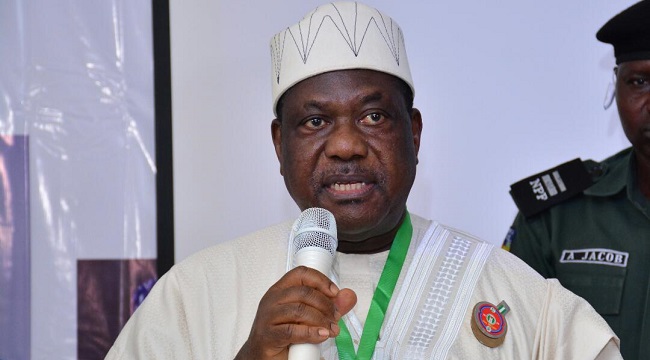
Secretary to the Government of the Federation, George Akume, has said Nigeria’s 27 years of uninterrupted democratic rule demonstrate that Nigerians have chosen the ballot box over violence as the preferred means of political change.
Akume made the remark on Tuesday during a news conference in Abuja held as part of activities marking Democracy Day. The event was themed, “27 Years of Uninterrupted Democratic Governance in Nigeria: Challenges, Achievements and the Roads Ahead.”

According to the SGF, one of the key lessons from the country’s democratic journey is that the will of the people must always be respected.
“The lesson first is that the voice of the people must always be supreme. It must be sacrosanct. That’s the beauty of democracy. The lesson is so clear. We prefer the ballot to bullets,” he said.
Akume reflected on the annulled June 12, 1993 presidential election, describing it as a painful setback in Nigeria’s democratic history.
“Incidentally, I also participated very actively in that election. That election was adjudged to have been free, fair, and very credible, and the election was said to have been won, and I believe rightly too, by Chief MKO Abiola.
“Maybe powers that be did not want him to be declared the winner, but collation had been done in most states of the country, including Kano State, where Bashir Tofa came from. There too, Abiola won.
“That election was annulled by the military government. It was very painful because the people spoke and they spoke freely. They made their own choice.
“There was no basis whatsoever for the cancellation of that election,” Akume said.
The SGF noted that the fallout from the annulment contributed to the adoption of power rotation between the North and South by political leaders in the country.
“June 12 (election) annulment had complicated the whole thing. It was finally agreed that we would be alternating between the North and the South.
“And basically, that is why any time I talk about this, I try to emphasise this issue of rotation. In the North, we’ll do eight years; in the South, eight years; in the North, eight years,” he said.
Also speaking at the event, Minister of Information and National Orientation, Mohammed Idris, said the conference was organised to commemorate Nigeria’s 27th Democracy Day and the third anniversary of the administration of President Bola Tinubu.
He described Democracy Day as an important occasion for reflecting on Nigeria’s democratic progress and honouring those who fought for democratic governance.
“Democracy Day occupies a unique place in our national calendar.
“It provides an opportunity for us to reflect on our democratic journey, celebrate the resilience of our institutions and honour the sacrifices of patriots who stood firm in the struggle for democratic governance.
“As we gather today, we pay tribute to the memory and enduring legacy of Bashorun Moshood Kashimawo Olawale (MKO) Abiola, whose commitment to democratic ideals remains an inspiration to generations of Nigerians.
“We also acknowledge the many Nigerians, including President Bola Ahmed Tinubu, who played significant roles in the pro-democracy movement and contributed to the restoration of democratic rule in our country,” he stated.
Idris described the country’s uninterrupted democratic experience since 1999 as a significant national achievement.
“It is a testament to the determination of Nigerians to uphold democratic values, strengthen national institutions and continuously strive for a more prosperous and united nation.
“This year’s Democracy Day celebration is particularly significant, as it coincides with the third anniversary of the Renewed Hope Administration.
“It offers an opportunity to take stock of our progress as a nation, review the impact of ongoing reforms and reaffirm our collective commitment to building a stronger and more inclusive Nigeria,” the minister added.
